The war, the not-war, the Strait-of-What-shall-we-call-it-today war, the war of lies. How shall we describe this war that the American President in his indisputable wisdom and unsurpassable smarts —the one who’s making America hotter by the minute, yes, that one—has chosen to throw the world into? However we might characterize this on-again-off-again fury plunging us in its off moments into farce, this year’s war has almost obliterated the memory of last year’s war. ‘Twas ever thus. Didn’t Euripides say a little something about the short-sightedness of men voting for war?
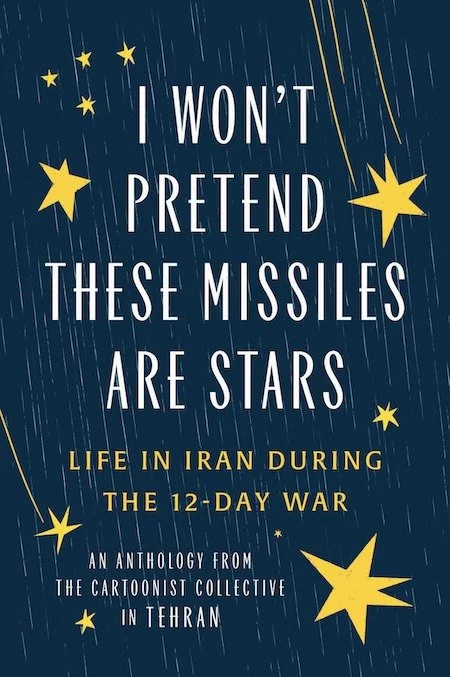
Cartoons, it turns out, are an apt medium to capture experiences and perspectives from within Iran on the 2025 war between Israel, the United States, and Iran (June 13-24, 2025). I Won’t Pretend These Missiles are Stars: Life in Iran During the 12-day War collects fifteen autobiographical stories by Iranian cartoonists who remain anonymous for their own safety.
An epigraph from The Cartoonist Collective reads:
In these dark days, nothing is more important
than spreading the voices of Iranians out there.
In the end, we have only one request:
remember us, remember Iran,
and speak loudly about it.
Because the artists are all anonymous, I decided I’d write something on every single piece in this anthology. No skimming over content by aggregating similarities together in summary. No reducing any of them to asides.
The opening piece, “12 Days,” begins like poetry with blinding light, traffic jams, an unmade bed. In a way, it prepares us for these individual testimonials to what it’s like to have a war blow into your life, your personal, intimate life that you thought you were leading. But that first piece also captivates with the colour choices it employs, the vibrant contrasts of orange and purple that draw the eye to poppies and apples. Only two colours frame the black pen work. They combine to deepen settings from couches to battlefields. They explode in the consciousness when curtains blow through broken windows and when the bombs fall.
In “I’ll Tell You a Story If We Don’t Die,” the narrator’s family faces choices, driven by the reality of a pregnant sister, against the pronouncements on TV of a faceless government. Numbers and letters scratched into darker backgrounds add to the movement of a slice-of-life narrative. Then the war ends—or does it?
The titular “I Won’t Pretend” plays out in boxes of solid colour and lines that sometimes contain reality and sometimes project the unthinkable, “as if we were nothing but lost causes.”
“Nothing” is about what one can get used to, about anger directed toward those who should be protecting the nation and are instead “busy fining people over hijab.” The protagonist reflects on past protests , on people killed by the government, on daring to hope. One compelling panel shows him lying on his back, a plant flowering from his chest. In refusing to give up, hope is stubbornly chosen.
“Four” plays out like a visual board game, each page tracking four experiences, each one driven by the narrator’s interior framing of events. Light touches of colour differentiate the viewpoints, while the line work crosses from one to the other and four renderings of plates smashing draw the viewer’s eye counterintuitively upward and back toward a rereading.
“Deadline With Letters” tracks Mona in Iran, corresponding with a John Doe editor who’s anxiously inquiring after his author-illustrators’ welfare while she’s obsessing over inking the work and the family goes to Tehran so Mehran can get a date for his thesis. The war ends and nobody meets their goals, while the last we hear from the editor is a quibble about “tiny lettering adjustments.” Happiness, we find, is a fickle thing.
A perplexed cat with a rich array of cat reactions to the human world, carries the emotional heft of “Lappe Letters” and manages to land moments of humour in ways that only felines can do for the humans who love them.
A young woman, her beautifully defines eyes drawing the reader through the tale, bizarrely declares she’s always wanted to be a mortician. In sweeping curves of flat black against blue washes, she prepares herself for death “like a mortician on overtime” in “Memento Mori.” Crying over heirlooms, she finds herself meditating upon the nature of war.
Golden frames of the ordinary world of “My Dream City” transforms into indigos and purples as the war hits. The transition is painfully mundane, with people asking, “should we go outside?” and the character wondering how this could happen in a place where nothing ever happens. When the war ends and the quotidian world appears, once more colour marks the shift but the text makes clear that what was once possible has now vanished.
The bodies of the characters are the focus of the art in “Stay Alive” while the text teases out the politics and the dread, the deep unhappiness of being caught in a war over which you have no control.
“A Safe Place” plummets from longing for a secret love hidden from the narrator’s family to the terrors of war and into a final reunion. Here, too, streaks of colour mark shifts in the events and the moods they engender.
“Under the Same Roof” documents the passage of days in the small details of individuals’ reactions to major news events—the bombings, the targeted killing of political leaders. A cousin prone to drama creates friction. Family members clash over politics whole an auntie teaches everyone to knit. More people keep coming. The rooftop provides refuge, until it doesn’t.
The war is “shock…spreading like ink in water” in “Until After the War.” A dormitory evacuates and the narrator wonders about “our humiliation and our erasure from history into stories,” a musing whose uncomfortabe self-reflection feels intended to stop a reader short.
For the narrator of “Tehran Apocalypse,” going to Tehran and getting an internship means escape from the stifling embrace of her family —until the war hits. The cat in the back of the car, hairball, claws and all, is a perfect metaphor. Home being as acrimonious as it was before, the young woman knows she has to leave again, and so she does…”I knew, no matter what, I need to find my own way.”
“The Fireworks” deals with adults lying to children to protect them, yet being forced to admit that war can arrive on their doorsteps.
The current war without end has managed to morph out of the wreck of this book’s war. Given the geopolitics of the region, that is sometimes framed as inevitable, which, this book suggests, no war should be. With each new spiral of war, more civilians die, more young lives are blighted. and this collection’s shining relevance remains undimmed. I Won’t Pretend These Missiles Are Stars is marketed for an adult audience. That must include the politicians who make and perpetuate war.