A Half-visible Map: Reading Projects Itself into Writing
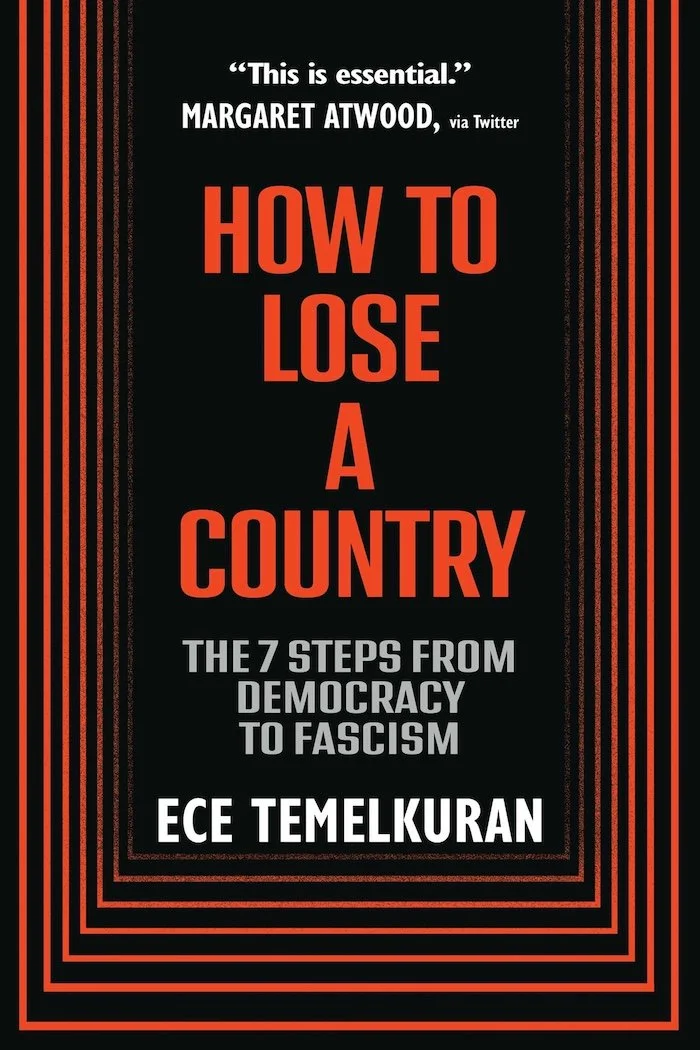
How to Lose a Country: The 7 Steps From Democracy to Fascism by Ece Temelkuran is rooted in the author’s experience in Turkey, but the picture it draws is of the rising neo-fascist right, not just in one country but around the world.
When I’m thinking of a work in progress, I tend to use everything I read as a filter for the undeveloped work. So I read Ece Temelkuran’s nonfiction work of politics, history, and memoir while simultaneously reflecting on entry points into a verse novel that is still a drafty patchwork of intentions and plot and half-formed characters. The world of the novel is a dystopian North America. Like a few other early drafts, it was dashed off in a great fury and then put away for a year or two, or five, to marinate in its own juices, depleted of the urgency that sent it spiralling up in the first place. My process, be warned, is messy, and I wouldn't recommend it to anyone. You go find your own way to mess up.
But one thing is indisputable: real life sparks fiction. It’s no coincidence that this idea arrived in nascent form when 47 was still 45. After the United States electorate, squeaking through January 6th, 2021, managed to get rid of the wannabe dictator in his first round, I wondered if the whole project had lost its potential. But then the neo-fascists came back on steroids, and the patchy draft feels worthy of my attention once more.
And so to the seven steps, tidily packed into seven chapters. Their titles ringing with outrage at what happened in Turkey, they are signposts on the road for other countries at risk.
Create a Movement
Whether it’s the “movement of the virtuous” in Turkey, MAGA, or Nigel Farage’s “victory for real people,” the antidemocratic pivot begins with building a movement rather than a party. You are suffering, the politician says, and we will save you. They build victimhood—those people (fill in enemy of choice) are out to get you and we—yes? See the pattern? Thus majorities begin to shape themselves into angry victims seeking retaliation, never mind if the enemy is largely invented.
Disrupt Rationale/Terrorize Language
Temelkuran puts it this way: “In recent years, countless people in several countries have found themselves… having to defend the truth against those who just don't feel like believing them. The most bitter battles of basic communication became routine, first on social media and then on TV screens. There were no rules of war to regulate behaviour in these battles, and the looters of the truth rampaged unconstrained.” She traces the devolution of politics into a mockumentary. It rings, well, true.
Remove the Shame: Immorality is “Hot” in the Post-truth World
In a world where all opinions are worth airing and none are considered too cruel, too rude, too shameful, the loudest voices will prevail. Hence fake news, barrages of lies, and a “post-truth” world with, if you recall, alternative facts. They lead, of course, to alternative diagnoses, alternative science, alternative realities in which the powerful are always right and we’re told we can’t believe our lyin’ eyes.
Dismantle Judicial and Political Mechanisms
In short, win an election, push the opposition into the margins, pack or weaken the judiciary, legally or otherwise, get your backers riled up enough to “safeguard” elections so the strongman never loses again.
Design Your Own Citizen
Authoritarians are usually quite clear about who the ideal citizen is. If she's female, she's going to need shaping and dressing and quieting. Unruly minorities also need redesigning—or villainizing, torturing, and so on.
Let Them Laugh at the Horror
In the final chapters, we get to the pushback—the Mothers of the Plaza del Mayo in silent contrast to carnivalesque approaches. Yes, think of frog costumes, think of satire, defiant dancing, gallows humor, poking fun at the tyrant, all ways to keep resistance alive.. From Bakhtin to the riotous Orange Gnomes of 1980s Poland, celebration and laughter binds people who are trying to resist. Laughter occurs, Temelkuran suggests, “at humanity’s emotional limits.”
Build Your Own Country
If you can. When you start to feel the country you knew is no longer recognizable, as if you are standing still but the land has moved beneath your feet, then you have to make a new way to be in the world, whether you remain or leave. The book ends with a longer view, one that leaves us imagining that at some point the fraud will reveal itself, if only because time moves on and eventually there will be no “uncontaminated edges of the world” where we might flee.
If the future is a map, most of us can’t see it too clearly. Occasionally, someone, Cassandra-like, catches sight of patterns, experiences events and spots their precursors in wider contexts. This is what Temelkuran does so effectively. Her conviction and clarity carry tragic echoes of another story reprised for our time—that of Douglas Kelley, the psychiatrist whose role in the trials of Nazi leaders forms the storyline of the movie Nuremberg. Kelley’s warnings are captured in a line in the movie, drawn from a paraphrase by Jack El-Hai, author of a book titled The Nazi and the Psychiatrist: Hermann Göring, Dr. Douglas M. Kelley, and a Fatal Meeting of Minds at the End of WWII, on which the movie is based. He describes the Nazis on trial as men “who would not hesitate to climb over the backs of half the people in their country to subjugate the other half.” Sounds familiar, yes?
Sometimes it feels selfish to want to write stories when real problems need solving, but this is how I make meaning of the world. And so I steep my reading in the expectation that I will see patterns in the events around me. I can only hope that my fiction proves capable of rising to the occasion.