Guest Post: Adi Rule on Ghost Chickens: Omelet from the Other Side
Florence Fortescue is an aspiring journalist. She’s also ten years old, that marvellous age of awareness when a kid lands at last in the double digits and the world is opening up but there are those pesky adults trying to hold you back in your bid to make a trail, strike a note, make a mark all your own. She’s also wonderfully bossy, with a dizzying faith in her own competence combined with solid reliance on plain old good luck.
Florence’s parents have insisted on moving her to the country and her best friend has been left behind and if that isn’t bad enough, there are ghosts.
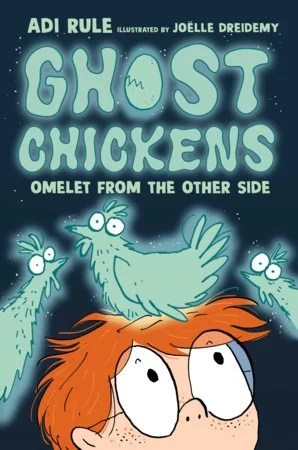
Adi Rule is a VCFA graduate from the program where I taught for sixteen years and this is her new middle grade we’re talking about, Ghosts Chickens: Omelet From the Other Side. It’s peopled with eccentrics of all ages and species. Songwriter Dad collects glass owls. Mom designs submarines. The ghost chickens appear after Florence eats a weirdly glowing green egg.
But I get ahead of myself. Back up a minute. The book starts here:
WARNING
If you ever find a mysterious, glowing egg
beneath the rotten floorboards
of an abandoned chicken coop
in the dead of night,
do not touch it.
I asked Adi to write about an element of this joyfully weird little book that helped bring the story to life for her. Most writers talk about characters or setting—big picture stuff like that. Adi chose to write about something delightfully subtle and writer-nerdy—how the text appears on the page, how it scans, what it looks like. In other words, the visual impact of language. The kind of thing you long to spend a writing day thinking about. Welcome, Adi!
Visual Elements of Voice
by Adi Rule
I love playing with the appearance of text on the page, even though I’m not a poet or picture book writer. Voice above all is my motto with this book, and everything I write. I mean, that’s not revelatory. I’m sure many of us feel that way!
With Ghost Chickens, visual cues were especially important to me—things like italics, capitalization, white space, quotation marks, parentheses, ellipses, and paragraph breaks. Of course, there’s the wisdom of letting the words do their work. But any way you’re visually setting off language in prose creates a bump in the “flow state” of reading and works with (or against) the words themselves in shaping the voice of the scene. (We actually read italics and all-caps text more slowly than roman text!) I found that Ghost Chickens, which has an over-the-top plot and main character, could handle a bit more of that kind of shaping—a few more of those bumps and slowdowns—than a quieter story.
The protagonist, Florence, is A Lot. She’s precocious, confident, daring, and spirited. I wanted that to come through not only in what she says and does, but also in the pacing and dynamism of the text. For example, when she’s excited, I tend to use short paragraphs and a heavier hand with explicit visual emphasis:
But if it was a chicken, where does it live? Could it have been a . . . wild chicken?
“I ... don’t want to micromanage readers’ experiences; my way of reading a scene doesn’t have to be the only way to read it. ”
Are there wild chickens?
Are they dangerous?
Even though it’s dark, I can tell there are no other living things in this coop with me. (Except spiders.) And that’s when I know, for real . . .
The cluck I heard must have been supernatural. That can only mean—
GHOST CHICKEN!
Now I have a story!
It can be a fine line to walk, however, because too much visual emphasis, even in silly middle grade, can begin to weaken the effectiveness of the technique. It can also pull readers out of the text—especially if they’re getting the same information in multiple ways. (“OH, NO!” he shouted, for example, conveys his loudness through both the all-caps and the dialogue tag. Depending on the context, a reader could find this redundancy funny or frustrating.) I also don’t want to micromanage readers’ experiences; my way of reading a scene doesn’t have to be the only way to read it. So I’m always checking in—does the humor land if this word isn’t italicized? Does the timing still work if there isn’t a paragraph break there? Does the meaning come across if I don’t use parentheses? I think of it like directing a play in which the reader is the actor. Where do I really need to give them specific instructions, and where can I just let them do their own thing?
With the audiobook, of course, all this is up to the narrator. (I am beyond fortunate that the Ghost Chickens audiobook is going to be amazing!) For readers who meet Florence and her ghost chicken frenemies via ink and paper, I want the experience to be just as fun, due to Joëlle Dreidemy’s hilarious illustrations and, hopefully, the playful appearance of the text.
A play in which the reader is an actor. It’s such a great way to frame the reader as co-creator of a story, with all our words functioning as stage directions. Thank you, Adi. Lucky for readers, the charms of the country creep up on Florence and she has a cleverly drawn and hilariously weird adult ally in Mrs. Penrose. I can’t wait for our Florence to return, finding new sources and more rampant chaos to investigate.