Process Talk: Traci Sorell on Riding the Trail
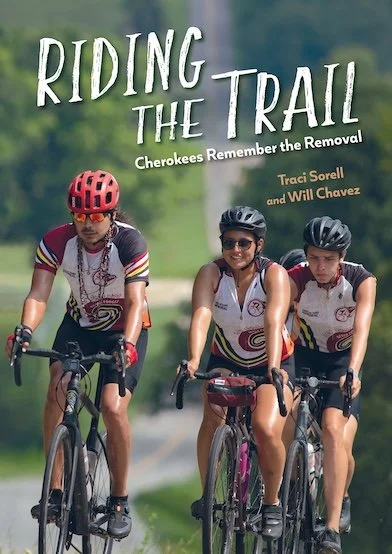
Riding the Trail: Cherokees Remember the Removal by Traci Sorell and Will Chavez is a tribute to history and the present, at once honoring ancestral tragedy and present-day community. When a Cherokee Nation biking team gathers to replicate a ride that took place in 1984, retracing one of the routes of the Cherokee forced removal of 1838-39, it’s a journey that unlocks the past in body and soul and spirit.
Traci Sorell, I’m so delighted to e-chat with you about this vibrant book, packed with information and illustrated with maps, original documents, art, and photographs.
[Uma] “They’ve waited two years for this moment.” From the very first sentence of your introduction, this is a book about collective effort, not only in the present but also spanning decades, and not just that, reaching back to the 1800s. It not only observes past injustice and grief but also celebrates collective joy. What led you to want to tell this story in this way?
[Traci] This is who we are as Cherokee people. Nothing happens without each other—the collective of community. It’s part of our core identity from the teachings of those who came before us. Of course, there are examples of individuals or small groups going against those values in our history. But overall we work together, which is a struggle within a settler-colonial country that centers the individual over the collective. The way the team stayed together and encouraged each other as well as the Cherokee Nation focused on everyone’s safety within a global pandemic and the knowledge that our ancestors kept caring for each other on their difficult journey helps us feel joy because we all survived.
[Uma] Yes, the story is also about picking up this plan that had to be set aside during the pandemic. The ride is a grueling physical challenge and your book spotlights the young people who stepped up to take it. That in turn becomes a narrative about language and culture and building a memory that will last into the future. How did you go about pulling all these threads through the book to weave together as they do?
[Traci] Honestly, we just followed the path laid out by the ride’s founders—Mike Morris and Mose Killer—along with all those who shaped the experience since then. The bike ride was never solely about the physical challenge, but rather about addressing all the parts of our Cherokee identity through the lens of this difficult historical chapter to propel young people into a balanced life of reflection, service, and self-care for their mental, emotional, spiritual, and physical well-being.
[Uma] This book is a collaborative effort, where writing is so often a solitary endeavor. Can you talk about the process of working with your co-author, Will Chavez?
[Traci] For me, writing requires a lot of collaboration. I talk to many people or reference their work whether I’m writing fiction or nonfiction. There’s just simply too much I’ll never know about any subject or feeling, so I rely on others who know more than I do. Collaborating with Will was a natural extension of my usual process.
As a member of the 1984 inaugural ride, the first mentor rider in 2017, and then the team’s coordinator and trainer for many years, Will contains so much knowledge. From helping select the riders to guiding their preparation and later managing the ride, his experiences helped me process my own when I followed the riders. His writing about the ride’s history and the modern-day journey centered past and present riders while helping others who will read the book understand what a transformative chapter this is in each rider’s life.
[Uma] Every book teaches the writer something. What did you learn as you worked on this one?
[Traci] What didn’t I learn! Whew, this book changed me forever. I believed middle grade, long form nonfiction (a new format for me) would be the most challenging part. That elicits a deep laugh now as I recall that naive thought.
Will and I sold this book on proposal in 2019. We planned for me to follow the riders in 2020. Of course, no one knew a global pandemic would soon engulf our daily lives. The losses within the Cherokee Nation were staggering, especially among our elders and Cherokee first-language speakers. Having the ride cancelled in 2020 and waiting until everyone could be vaccinated the following year kept us all safe. Following the riders to various places within our homelands affected me more than I anticipated. Seeing the beautiful places our ancestors lived, areas where they suffered in internment camps with many dying before ever leaving the Cherokee Nation, and then traveling through the vast area they traversed after entering the United States felt overwhelming. I knew it must have been for our ancestors too since they had no idea what awaited them on that forced journey or what they’d find when they arrived at the other end.
In a follow-up research trip two years later, I visited where my ancestors lived prior to their roundup and internment. It reinforced my earlier decision not to write a book only focused on that chapter in the story of the Cherokee people. While we live with that history every day and wouldn’t live where we do now without the forced removal, I wanted to show that Cherokees are still here and continue to make meaningful contributions to the world around us just like our ancestors did.
Riding the Trail is the hardest book I’ve ever written, but I’m grateful for the journey it took me on as a writer and a Cherokee woman.
[Uma] A truth-telling journey—what is this book saying to young readers about that?
[Traci] I believe reading nonfiction is as vital today as it has ever been. Some people do not want you to know the truth about what occurred in the past or what is taking place right now. But rest assured, there are witnesses. Just like there are those who recorded the events and shared the stories in prior eras. Seek out those sources of information and always strive to be an informed, involved community member.
[Uma] “Rest assured there are witnesses.” Traci, that is powerful stuff, the idea that truth remains, even when someone seeks to erase or elide it—there it is, waiting to be told and heard. Thank you for your thoughts and thank you for writing this book, a tribute to the potential of remembering together.