Guest Post: Kaua Adams on An Expanse of Blue
Kauakanilehua Māhoe Adams and I crossed paths two years ago over a project I’d been nurturing for a while. She is now my collaborator on this work, which is absolutely all I can say at the moment. We hope that one day, it will find a form that honors the material and people that have moved us both and brought us together as partners in craft.
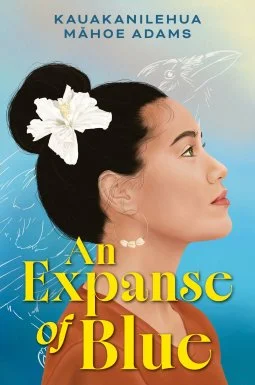
Cover Art by JT Ojerio, art design by Molly Fehr
Coincidentally, I was delighted to find out that Kaua is also a graduate of the VCFA MFA program in Writing for Children and Young Adults where I taught for 16 years.
Kaua writes poetry and short stories and now she has written a verse novel, An Expanse of Blue, that draws on her own Hawaiian heritage. Her protagonist, Aouli Elizabeth Smith, known as Lily to those who can’t pronounce her Hawaiian name, is our window on the cultural nexus of Hawaiian people living on the mainland, in this case south of Seattle. Aouli’s a teenager with a teen’s longing to navigate her own life in her own way. She’s sulkily resentful of her father, irreverent in church, and pining for Damien Miller, one of four brothers, “each one year apart/with a name that starts with D./Yeah.” It’s alternately knowing and aspirational, expressing one girl’s emotional journey as she struggles to find herself when her strict, unapproachable father turns out to have feet of clay.
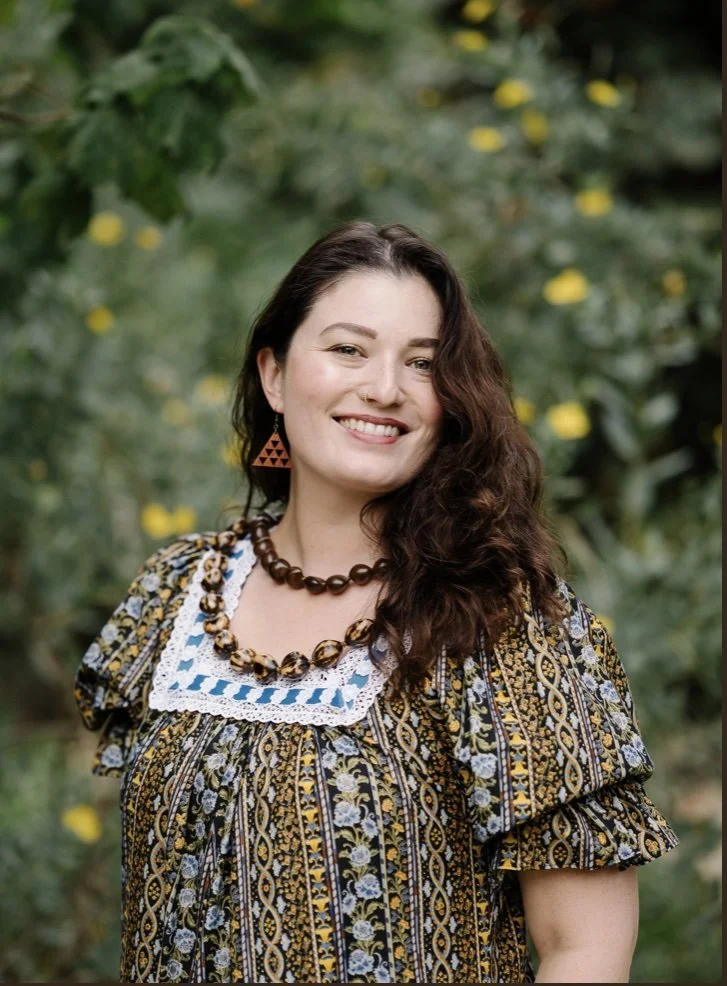
Kauakanilehua Adams, photo © Marie Monforte
The verses use white space, repetition, occasional near-rhyme, and the musicality of assonance, as well as numerous elements of concrete poetry, all while staying unerringly within a single viewpoint. Aunty Ehu is especially wonderfully voiced, an adult mentor character who evokes Aouli’s yearning for a home built on affection rather than rules. Along the way, this book also captures that terribly wrong-headed and terribly common assumption of the young, that everything going wrong in a family must be their fault. In the end, it serves up complexity and offers the hope you find when you give yourself grace.
Here’s what Kaua has to say about the making of this book.
The Writer I Am
Kauakanilehua Māhoe Adams
For a long time I was obsessed with the idea of being a certain type of author. One whose process was perfectly efficient, shiny to show off, and just like the professionals.
This desire though, to look like a real writer rather than do real writing, ended up just costing me a lot of time and money and grief with very little to show for it. I spent years trying to shape myself into the image of what I believed a writer should be instead of allowing myself to be the writer that I am.
“I wrote the kissing scenes when I was feeling bored and the funny scenes when I was feeling sad and the tough scenes only when I had on my favorite pajamas and a mug of my favorite vanilla almond tea in hand. ”
The path to finally writing An Expanse of Blue, the first full-length novel manuscript I ever completed, was one littered with unused journals, highlighters still in the package, unread books on craft, half-done plot outlines, abandoned writing schedules, and forgotten subscriptions left on auto-pay to every writing app, program, and software claiming to be able to whip me into writerly shape and organize my messy ideas into something resembling a book.
Eventually, however, I had to consider the possibility that maybe all the time I spent searching for the right thing to perfect my process was just a way to avoid the scary inevitable. If I wanted to write a book, I was going to have to actually write it at some point.
The trade-off I promised myself was this: I have to write the book, but I get to write it my way.
I allowed myself all of the things I love most about telling stories. I spent a fair amount of time daydreaming, staring out the window, letting my mind wander, talking to myself, talking to my dogs (waiting for them to talk back), and I counted that all as writing time. I freed myself from the expectation of keeping “professional” hours. I wrote early in the morning, late at night, for five days in a row and then not at all for three. When I knew I had to finish the scene I was working on, I forced myself to do it (because sometimes you have to) and when writing was driving me up the wall to the point of madness, I gave myself a break (because I am only human). I wrote the kissing scenes when I was feeling bored and the funny scenes when I was feeling sad and the tough scenes only when I had on my favorite pajamas and a mug of my favorite vanilla almond tea in hand. When inspiration struck, I didn’t let it out of my sight. When inspiration didn’t come around for a bit, I lamented with friends, I vented to my husband, I tried to talk it out with the dogs (unfortunately they care a lot more about treats than they do plot). And eventually, good ‘ol Inspiration came back around again (she always does).
The result of this approach (my process one might call it) was my debut novel. It’s not a perfect book, but it is an honest one. One that was created in a way that feels faithful to who I am as a poet and a storyteller. One that I truly enjoyed writing. And as the release date of this piece of my heart into the world quickly approaches and the nerves start to really kick in, the truth of its wonderfully messy creation is enough to bring me peace.
That journey, from wanting to be “a certain type of author” to elevating practice over inspiration, will be recognizable to many. Octavia Butler wrote, “Habit will help you finish and polish your stories. Inspiration won’t. Habit is persistence in practice.” Kaua’s reflections suggest that each of us with the drive to write must build the habit that works for us, whether or not it works for anyone else. Keep returning to the work and inspiration sorts itself out.