Guest Post: Stephani Eaton on Taking Her Writing Life Off the Page
One of the great joys of having taught writing for a couple of decades is hearing from former students about their journeys beyond our time together.
Stephani Eaton was one of my students who wrote delicate, inviting picture book text. She also had a rare feel for what lay beneath the words in books she read. Even her essays were fun to read. I always looked forward to seeing her work in the monthly packets that my teaching life revolved around. But we connected in other ways, too, around reading and history and always the way that stories manifest in life.
It turns out that story can take many forms in a writer’s life—and some of us need jobs that involve engaging with other people on a daily basis. Here’s Stephani on how she walked her writing mind into quite another space—a museum. Here’s a museum with a layered and complex history that takes patience and inquiry to unpack and interpret. Stephani reflects on her role in doing just that.
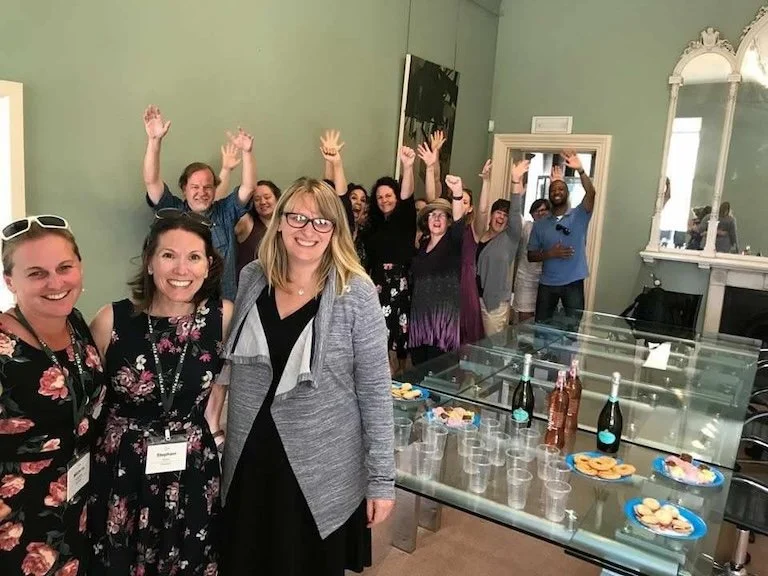
2018, VCFA Bath Spa residency, celebrating graduates—Michelle Houghton, Stephani Eaton, and Rachel Purcell in foreground. All photos courtesy of Stephani Eaton
Space for Meaning
by Stephani Eaton
When I graduated from Vermont College of Fine Arts with my MFA in Writing for Children and Young Adults in 2018, I thought I knew how my story would go.
For a while, it unfolded just as I’d hoped. I signed with an agent. My middle-grade novel went out on submission. I stepped into the role of managing editor for Cynsations, Cynthia Leitich Smith’s kidlit blog. I was immersed in story.
But something was missing.
It took the stillness of COVID to reveal what I hadn’t wanted to admit: I missed people.
Not fictional people, though I loved them deeply. My days had become quiet and solitary, populated more by imagined lives than lived ones. I found myself starved for the energy of real human connection.
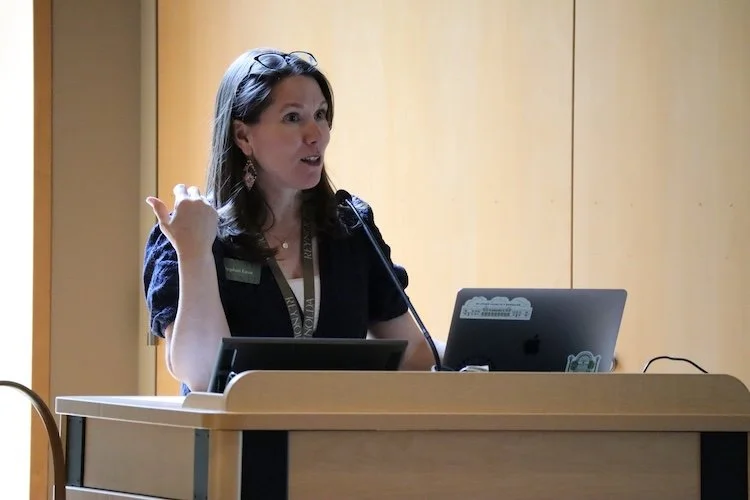
Stephani teaching the Sharing the Story of Reynolda docent preparation class
In 2022, I found the unexpected next chapter of my story at Reynolda House Museum of American Art and Reynolda Gardens, where I now serve as Manager of Tours and Volunteers.
On paper, my job is managing about 200 volunteers and developing and scheduling tours. In practice, my work is what it has always been: story.
“Together, we’re unearthing the emotional truths beneath the factual surface. Most importantly, volunteers are discovering that the real magic of storytelling lies in the audience’s connection to it.”
Since arriving at Reynolda, I’ve written five tour resources for our guides. These are not scripts. They are story frameworks—carefully researched histories shaped into narratives that invite curiosity. They help volunteers share not just what happened, but why it mattered, and how to help visitors connect to it.
I also teach our docent preparation course, which I’ve titled Sharing the Story of Reynolda. The emphasis on story is deliberate. Volunteers aren’t memorizing facts; that’s because stories have a voice. Each volunteer shapes their own tour. Many volunteers arrive assuming they need to master dates, terms, and biographies. Those details matter, but what transforms a tour is story structure: tension, character, and change. Why did Katharine Reynolds build this place? What did it mean to those who lived and worked here? What echoes remain today?
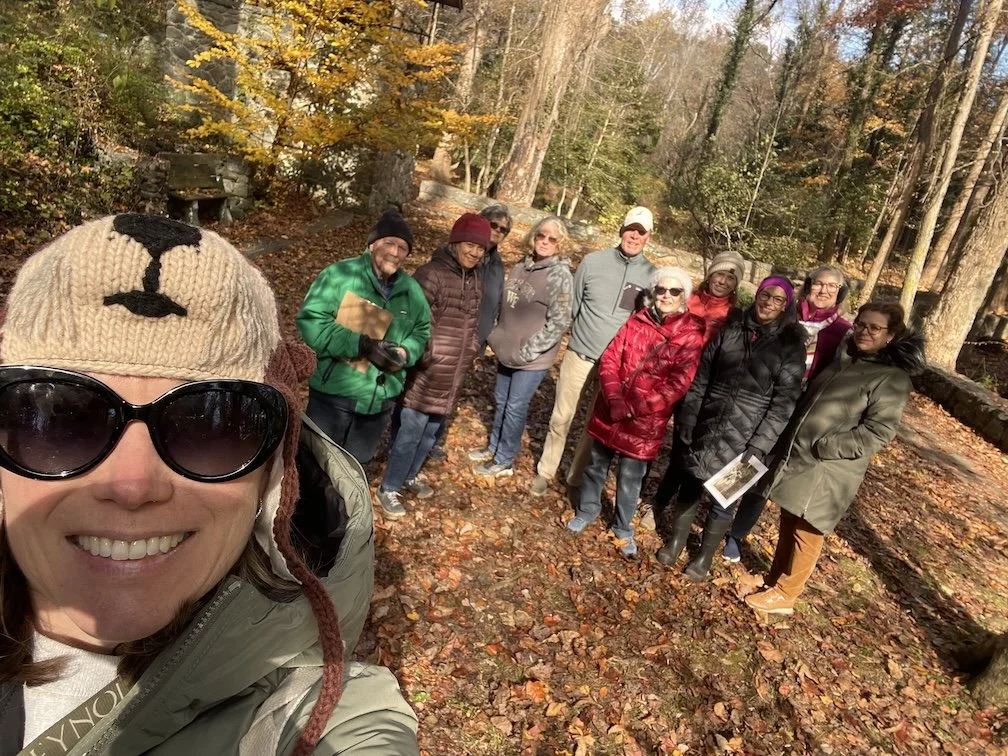
Training volunteers to lead the Waterways of Reynolda tour that shares both the story of people who lived here and animal neighbors in the wetlands
As Lisa Cron writes in Wired for Story, “Story is what makes us human, not just metaphorically, but literally. Recent breakthroughs in neuroscience reveal that our brain is hardwired to respond to story; the pleasure we derive from a tale well told is nature’s way of seducing us into paying attention to it.” When volunteers understand this, they stop worrying about lists of dates and facts and start focusing on connection. They begin asking visitors to imagine. They create space for meaning to emerge.
This is the process that I love.
In many ways, I am doing exactly what my MFA trained me to do. I’m shaping narrative. Together, we’re unearthing the emotional truths beneath the factual surface. Most importantly, volunteers are discovering that the real magic of storytelling lies in the audience's connection to it.
Now the stories I shape live in rooms, gardens, and trails. They unfold in real time, between real people. And I, quietly, get to stand at the intersection where story becomes shared experience.
It turns out my writing life didn’t end. It simply found its way off the page.
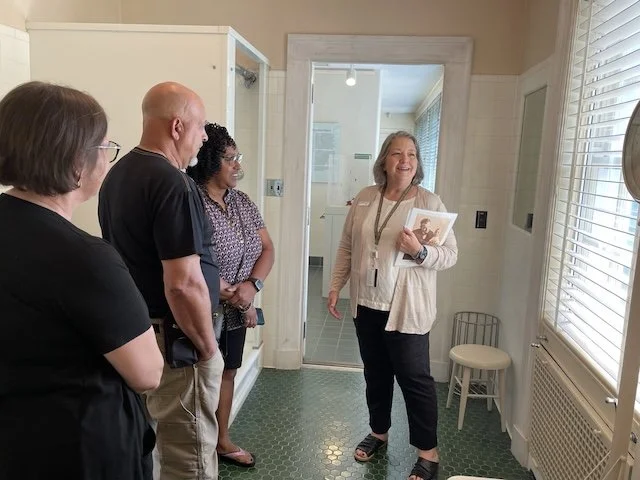
Cammie Berrier leads a members’ tour for Descendants Committee of Rock Spring Plantation. Photos courtesy of Stephani Eaton
The focus should be on connections over lists of dates and facts—and that means shining the light on understanding rather than recapitulating information. Thank you, Stephani Eaton.