Guest Post: Kirk Van Brunt on Fight Song
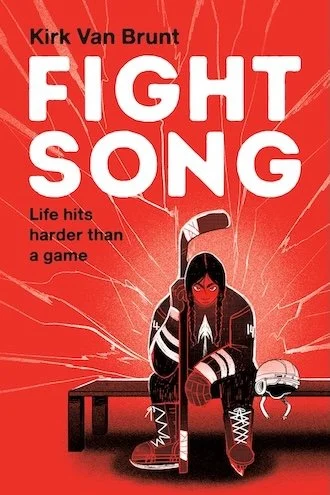
Fight Song is the story of a girl with voice and spunk.
“My name is Nokes Lasley. Nokes is short for Nópika, a name no one called me—its pronunciation isn't obvious, and it doesn't rhyme with any insulting words. Also, I didn't tell people my real name. Dad once told me Nópika was the name of a famous woman warrior who fought alongside the men of her tribe.”
Nokes is tall—six-foot-two, at the age of fifteen, on account of “a pituitary gland thing.” She describes her mother as “a mix of Native American and First Nations descent, but she died when I was five. Dad, on the other hand, was about as white as the driven snow and he wanted me to be too, so he made sure I had nothing to do with Mom's side of the family.”
Nokes plays hockey and she’s all set to be a superstar when her life is upended by her father’s arrest for murder. Escaping from a series of unbearable homes she’s placed in through the foster care system in Ontario, she crosses the border and manages to make her way to Minnesota. Starving and in stinking clothes, she’s in search of a friend of her dad’s who’s always sent her birthday cards. There’s optimism for you, and youthful determination, and a kind of fiery humour that flares up when she needs it most. And the girl can lie, which is what she decides to do. Height and skills on her side, she’s set to play hockey and build a new life, only the past won’t leave her alone. It’s a coming-of-age story that refuses to look away from difficult issues, while playing out against the thrill and intensity of life on the ice.
I invited Kirk Van Brunt to write about the making of this book. I am an impulsive, disorganized, messy writer. I feel my way through drafts and sometimes I give up too soon. Kirk’s essay warmed my writing heart.

Photo courtesy of Kirk Van Brunt
Fight Song: My Personal Groundhog Day
by Kirk Van Brunt
Everyone has seen the movie Groundhog Day, where Bill Murray is forced to relive the same day in Punxsutawney over and over again until he makes the right choices and escapes the time loop. I started writing Fight Song in 2018 and it became my Groundhog Day. No, I didn’t relive the same day. It was worse. I had to rewrite the same 35,000 words over and over again. Five times, actually, until I finally moved on with the sixth attempt. That’s 175,000 words—wonderfully written words, by the way—that have ceased to exist. Imagine J.K. Rowling writing Harry Potter And the Half-Blood Prince (168,000 words) and then deleting the entire file.
“I had broken out of the time loop and was moving forward. Finally.”
Chapter One never really changed. It was everything that came afterward that did. First, it was purely a Canadian hockey story about a First Nations girl. Sports with a little bit of high school drama. Meh. I bailed on page 132. Delete. Next, how about the girl is orphaned and sent to live with rich relatives in the US that she hardly knows? Hockey meets The Secret Garden. I got to page 120 before I had to stake it in the heart. Then, what if the girl runs away and . . . and what? Page 115. So I’m back at the end of Chapter One and asking, what would it be like if I was a poor Indigenous teenage girl who just lost her only parent? Pretty tough. Foster homes can’t be fun. Okay. Interesting. I made it to page 108, but she hadn’t even played her first real hockey game yet. The whole reason I got into this was to tell a hockey story, not simply an orphaned girl story. All right, how about I tell a hockey story in real time with flashbacks scattered throughout about her foster care journey? Well, flashbacks—particularly many, many long ones—can be really boring and readers tend to skip over them. I was getting closer, but the story was still not resonating. Delete with much cursing. So discouraging.
At this point, it’s 2019 and I took a big break to write another story, which I saw through to completion and publication (Adventures on the Road to Me). Writing that story gave me the critical vision and tools I needed and was missing before. So, in 2020, as COVID began ravaging the world, I decided to take another run at Fight Song, but this time it would not be a simple, linear story. In real time, Nokes is a homeless runaway in the US who claws her way back into hockey and succeeds, but interspersed in this timeline are pieces of the story of her harrowing journey through the foster care system. I got to page 140 and . . . I kept on going. What the . . . ? Then the story continued to spill out until, in August 2020, I was done with a first draft. Countless revisions followed as I queried the manuscript and then as my agent took it out on submission. But I had broken out of the time loop and was moving forward. Finally.
So what’s the takeaway from my personal Groundhog Day experience? I really don’t want to go back to Punxsutawney, so my primary focus needs to be, first, finding my character: Where is she? What does she want? Why can’t she get it? With that foundation, then I can turn to the journey: How does she get to where she wants to go? Finally, I simply need to put all that together in a way that captures and keeps the reader’s attention. Easy peasy, right? If only.
And after my experience with Fight Song, will I ever be caught in a writer’s time loop again? Sadly, probably yes.
A piece of writing can be guided by the metaphors we employ to think about it. It’s weirdly reassuring to think of that commonly felt confusion about the direction of a draft as a time loop. Keep showing up, keep the work brewing in your mind, and trust that the story will find its way. Thank you, Kirk, for unpacking your journey with this compelling book.