“You will eat a lot of bananas…” Ancestry and Self in Go-Between Girl by Andrea Gunraj
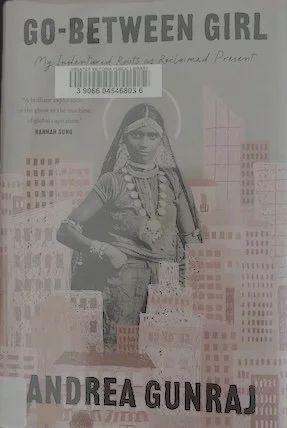
In an article in Write, the magazine of The Writers’ Union of Canada, Andrea Gunraj describes beginning her journey to learn about her own family’s story:
I learned nothing about the history of racialized indentureship in grade school. In university, I was taught fragmented facts. I committed to my own investigations as an adult.
Indentured labour is an integral part of the history of colonial expansion. It's often treated as an aside, a side-effect of the abolition of slavery, admittedly an evil but a lesser one. Yet this little known history reverberates through time, affecting generations after the actual events of indenture and the lives spent in servitude.
In Go-Between Girl: My Indentured Roots as Reclaimed Present, Andrea Gunraj explores the impact of her family’s elided past on her own actions and reactions, and on her sense of self. I’m always interested in how people from India created disaporic communities through history and how far-flung those connections are. I’d never seen this particular history addressed anywhere so I was very pleased to find this book in my public library.
Gunraj writes:
“Look brothers,” the recruiter said to him and the other recruits, “the place where you will work you will never have to suffer any sorrow. There will never be any kind of problems there. You will eat a lot of bananas and a stomach-full of sugar cane, and play flutes in relaxation.”
During my search for my ancestors’ experiences, I located all kinds of artifacts documenting the movements of racialized indentured people: work agreements, ship rosters, letters, adjudications, photographs. But official documents are limited inside into their choices, conundrums, and daily lives. There is no grand autobiographical traditional amongst them…
This is difficult terrain, and Gunraj traverses it with honesty and heart.
The only story I remember hearing was about a pair of young Indian boys tricked onto a boat to buy a white man. He lured them onto the gangway with treats, with tales of a fantastical far-off land. Months later, they landed on the shores of British Guiana, their parents and family presumably never informed where they had disappeared to. The boys never set foot in their homeland again.
Unpacking one of the few existing accounts, she writes of the testimonial of Totaram Sanadhya, an indentured worker or girmitiya. The word comes from a colloquial Hindi form of the English word “agreement”—who agreed to what remains tragically unclear.
“Look brothers,” the recruiter said to him and the other recruits, “the place where you will work you will never have to suffer any sorrow. There will never be any kind of problems there. You will eat a lot of bananas and a stomach-full of sugar cane, and play flutes in relaxation.”
The essays include anecdotes drawn from memory, like that of the author’s child self, tongue-tied and unable to respond to a teacher’s overheard, hurtful observation on skin colour; and too diffident to seek insights from family members.
The way adults in my family spoke of their Guyana homeland made it sound like a land of food and love and music and play. When I imagined them as children, I saw them amongst palm trees and sunshine, running and plucking fruit, mouths wide with laughter. There were times I wanted to ask them for more information about our Indian origins, but I wasn't sure what the purpose of knowing was.
One essay speaks to the origins of the word “coolie,” its descent into a range of self-critical aesthetic judgments, and beyond that, the reclamation of “Coolitude.”
How can you be known for great taste when you're hardly known to exist in the first place?
Others cover the role of compliance, of silence in the service of belonging, of the edges of otherness, interracial love, parallels between the experiences of oppressed peoples who might seem, on the surface, dissimilar, even the mirroring of colonization and indentured servitude in the gig work of today.
I read a chapter a day and let it simmer, a bit like the pepperpot with its mysterious cassareep sauce. You wouldn’t think a chapter on boiling cow hooves for days on end would hold the slightest appeal to vegetarian me. In truth, it made me think all day of cassava and of cultivated plants and the people who learn, over generations, the secrets of their use. Gunraj’s recursive, deeply personal account rises to another level when it shows how food shapes us in spite of ourselves, how we use it to touch a past we never knew but carry within us. Elsewhere, the story of cane is woven in, its cultivation making fortunes by linking continents through the bodies of those who worked the plantations.
The music of flutes, so deceptively promised to young Totaram, finds echo in the epigraph to the “Coolie-coolie” chapter:
“You are an artist in need of an image/ and your
dance is forever/ unknown by your roots.”
—Khal Torabully, To a Coolie, (translated from
the French by Nancy Naomi Carlson
Gunraj ends the book with a plea for shared identity, making a case for greater belonging, not by eliding the past but by insisting on facing it. “Basking in liminality,” she suggests, offers us all a way to connect in spite of ourselves.