Guest Post: Amanda West Lewis on Looking at the Sky, her Graphic Novel about Janusz Korczak
"Children are not the people of tomorrow, but the people of today. They have a right to be taken seriously, and to be treated with tenderness and respect. They should be allowed to grow into whoever they were meant to be — the unknown person inside each of them is our hope for the future." Janusz Korczak
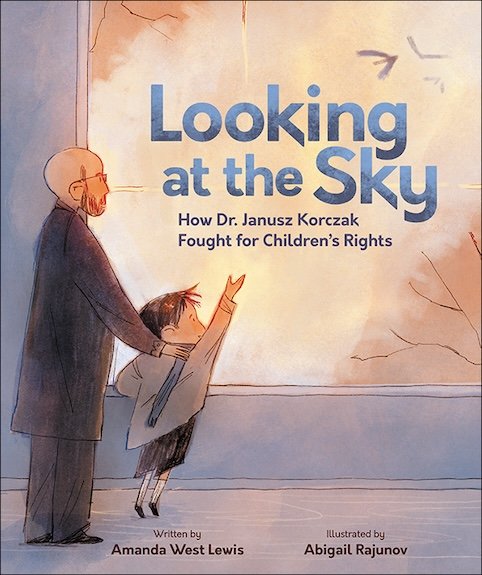
Looking at the Sky: How Janusz Korczak Fought for Children’s Rights, a graphic novel by Amanda West Lewis, opens with an epigraph, a quote from the subject of the book. Janusz Korczak’s words speak an essential truth we often fail to understand. Children have rights. They deserve to be taken seriously. Here is the story of a man who cared deeply about them, a man who spent his whole life taking children very seriously indeed. Illustrated by Abigail Rajunov in line work framed with soft washes of colour, Amanda West Lewis’s book conveys the joy and purpose of a life that ended in tragedy, yet offers hope and meaning to young readers.
The book begins with young Izaak being sent to Warsaw’s Dom Sierot (“Home of Orphans”) when his mother dies. There he meets the kindly Dr. Korczak, in whose care children are fed and looked after and also educated, stimulated, given chores, even given voice and accorded specific rights and roles in a children's court. The kids call Korczak by a Polish honorific, “Pan Doctor.” We see him through Izaak’s eyes, an interesting and sensitive viewpoint choice in light of the history that then unfolds. The graphic literature format goes a long way to helping achieve the book’s effect, so I asked Amanda to write about this particular story container. Here’s her piece, a testimony to the recursive nature of writing.
Finding the Right Container or How the Heck Do I Write a Graphic Novel?!
by Amanda West Lewis
I work in a number of different genres and media –– theatre, calligraphic book arts, literary arts. My books for young people are in various genres –– craft books, non-fiction books, picture books, poetry, middle grade, and YA fiction. For me, the challenge isn’t necessarily what to create, but which container is best for this idea?
By exploring ideas from many perspectives, I’ve found new things and come to a richer understanding of what I am trying to say.
Every creative project is different of course, just as the ultimate audience for each piece will be different. However, the project that culminated in the publication of my latest book, Looking at the Sky: How Janusz Korczak Fought for Children’s Rights, has had several incarnations. In fact, I’ve worked on the ideas in Looking at the Sky in different forms for over twenty years.
I first heard the story of Dr. Janusz Korczak in 2005 from the landlord of the theatre school I was running (The Ottawa School of Speech & Drama). Leon Gluzman had been a resident at Janusz Korczak’s orphanage in Warsaw after the First World War. Over eighty years later, Leon was still emotional when he talked about “Pan Doctor.”
Korczak was a Polish pediatrician, children’s right’s advocate, director of orphanages, and children’s book author. He founded the first national newspaper edited and written by children, hosted a regular national radio show for children and adults, travelled internationally to speak on how to educate and raise children with respect. In his day he was world-famous. That didn’t prevent his murder in the Holocaust. He died in 1942 along with 200 children and teachers from his orphanage.
Korczak’s important legacy was to change the way that people thought about children. He is revered for his commitment to young people. His writings became the foundation for the UN Convention on the Rights of the Child. But his work and life are not well known. After learning about him, I wanted to change that.
In 2006, I decided to work with a group of young people at the theatre school to workshop a play about Korczak. The students interviewed Leon and researched Korczak. They dove deeply into war-torn Poland and, inevitably, into the Holocaust. That two-year theatre workshop process was a moving and personal experience for all of us.
In 2009, we decided to take it to the next level and commissioned playwright Hannah Moscovitch to write a play to tell the story. I co-produced the premiere professional production of The Children’s Republic with the Great Canadian Theatre Company (G.C.T.C) in Ottawa.
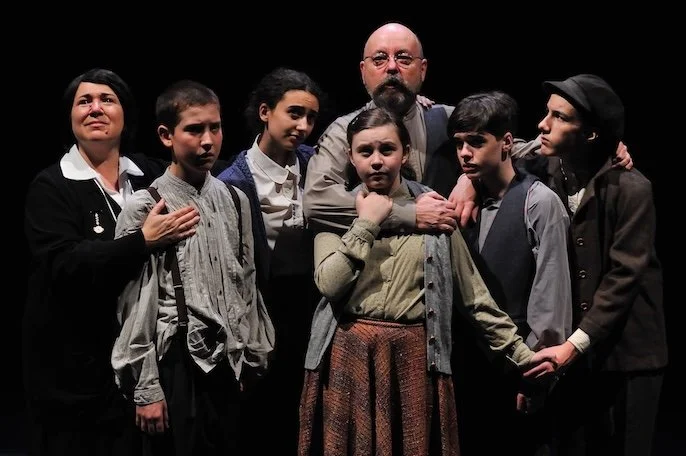
From The Children’s Republic, by Hannah Moscovitch, Great Canadian Theatre Company, 2009, photo © Andrew Alexander
It was wonderful to bring Korczak’s story to life on the stage. However, as the years passed after that production, I felt that I wasn’t “done” with the story. The play, while suitable for young audiences, spoke from an adult perspective. I wanted to introduce young people to Korczak’s ideas, to shine a light on his relationship to the children in his care, and to show what it was like to live in the orphanage. I wanted young readers to see how Korczak’s ideas could change lives.
But what kind of “container” did the story need? And whose perspective should I write it from? Korczak’s or a child’s?
In 2015, I launched into an MFA in writing for children and young adults. The “Korczak” story was something I kept coming back to, and I worked on it as part of my program, writing it as a middle grade biography. It came out flat and heavy. (My mentor at the time said, “I have to get you out of the Second World War!”) Then in 2017, I was studying picture book biographies and started trying to write his story as a picture book manuscript. At that point I knew I needed to tell the story from the perspective of a child. But I was having a hard time finding a way for the manuscript to be engaging.
I continued to research and explore different aspects of his life, but trying to contain everything into an 800-word picture book was a challenge to say the least! However, in 2021, I had a manuscript that I thought might work. I submitted it to my editor at Kids Can Press with whom I was working on A Planet is a Poem.
Her response was what my inner voice had been telling me, but I had been studiously ignoring. “There’s too much material here for a picture book.” But her next sentence took me totally by surprise. “Have you ever thought of writing a graphic novel?”
Truth be told, I never had. I had hardly read any graphic novels! But a graphic novel would allow more room than a picture book. I could show more details from Korczak’s life and philosophy and give a better sense of the times in which he lived. In particular, I could find a way to contextualize the Holocaust for a young reader.
I knew the story I wanted to tell. I knew the characters and the arc of the material. I leapt in and started researching how on earth to write a graphic novel.
“I learned that I could create pacing through the number of panels on a page. The size of the panels, how much text I used, even whether the panels were horizontal or vertical could influence the rhythm of the story. ”
Writing a graphic novel is like storyboarding a film script. Not that I’ve written a lot of film scripts. But I’ve written a lot for theatre, worked onstage as an actor, off-stage as a director, producer, and stage manager. Suddenly I was combining all of these skills but in a whole new container.
The first thing I did was to break the story down into small units, moments too small for a picture book. It didn’t take long for me to envision scenes and create “camera angles”. Close-ups and distance shots all came naturally as the “movie” began to play out in my mind. Each important moment, each significant reaction, could have its own “frame.” I learned that I could create pacing through the number of panels on a page. The size of the panels, how much text I used, even whether the panels were horizontal or vertical could influence the rhythm of the story. Panel size and frequency could create tension.
When you write a picture book, you give as little direction to the illustrator as possible. The opposite is true with a graphic novel. I wrote descriptions of each panel on each page, even to the extent of the orientation and size of each panel. In essence, I gave the illustrator a road map for the emotional life of the story (as well as specific historical details). They could then take that map and made it their own.
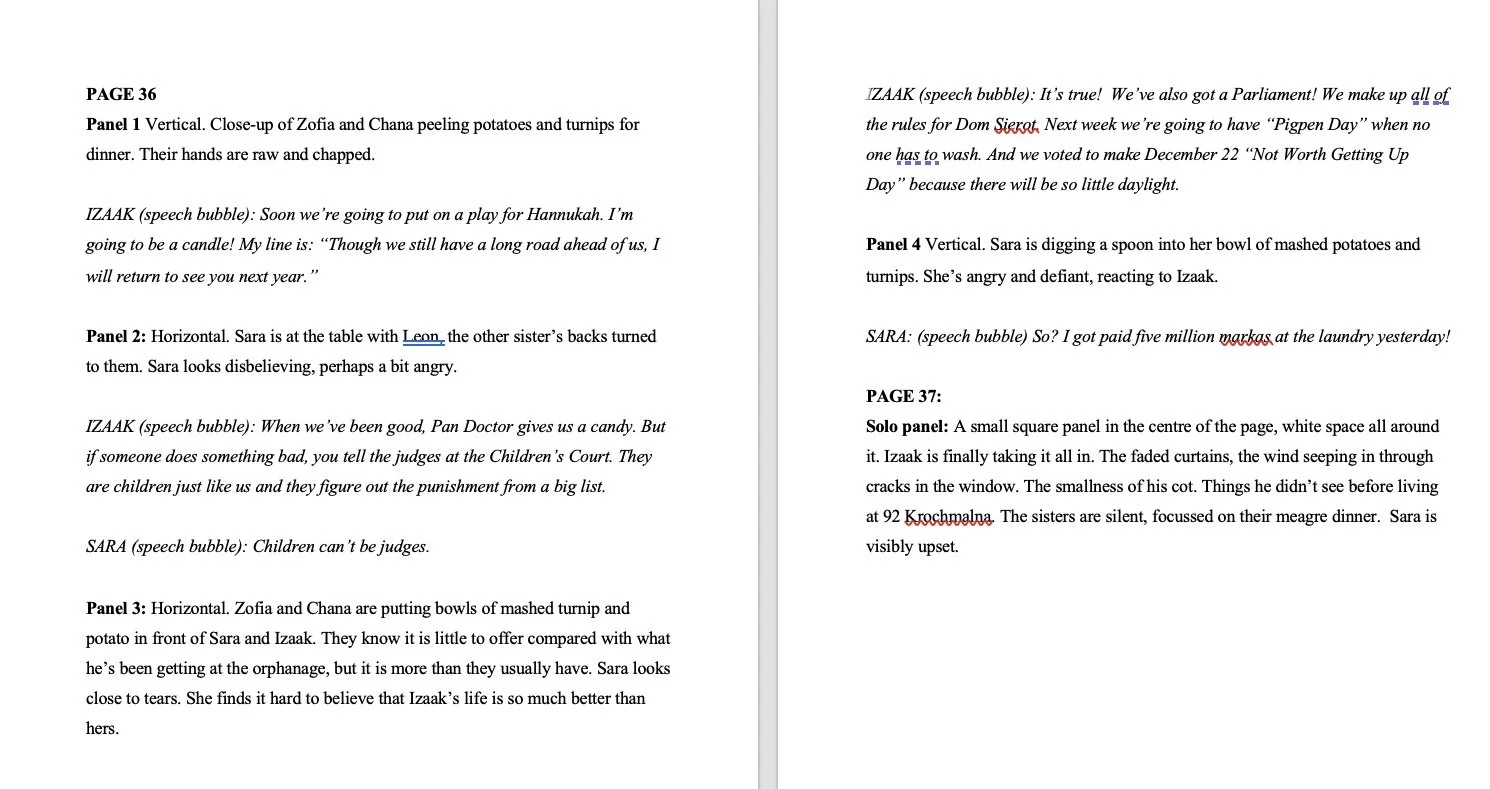
Draft manuscript pages 36 – 37, Looking at the Sky ©Amanda West Lewis
Not all publishers would go out on a limb and develop a graphic novel with a writer. Most graphic novels are written and illustrated by one person. But Kids Can decided that the story was important enough to take a chance on. They contracted Abigail Rajunov to take on the immense challenge of illustrating this complex story. Abigail took the skeletal framework I had written and turned it into a sensitive and evocative story that far exceeded my expectations.
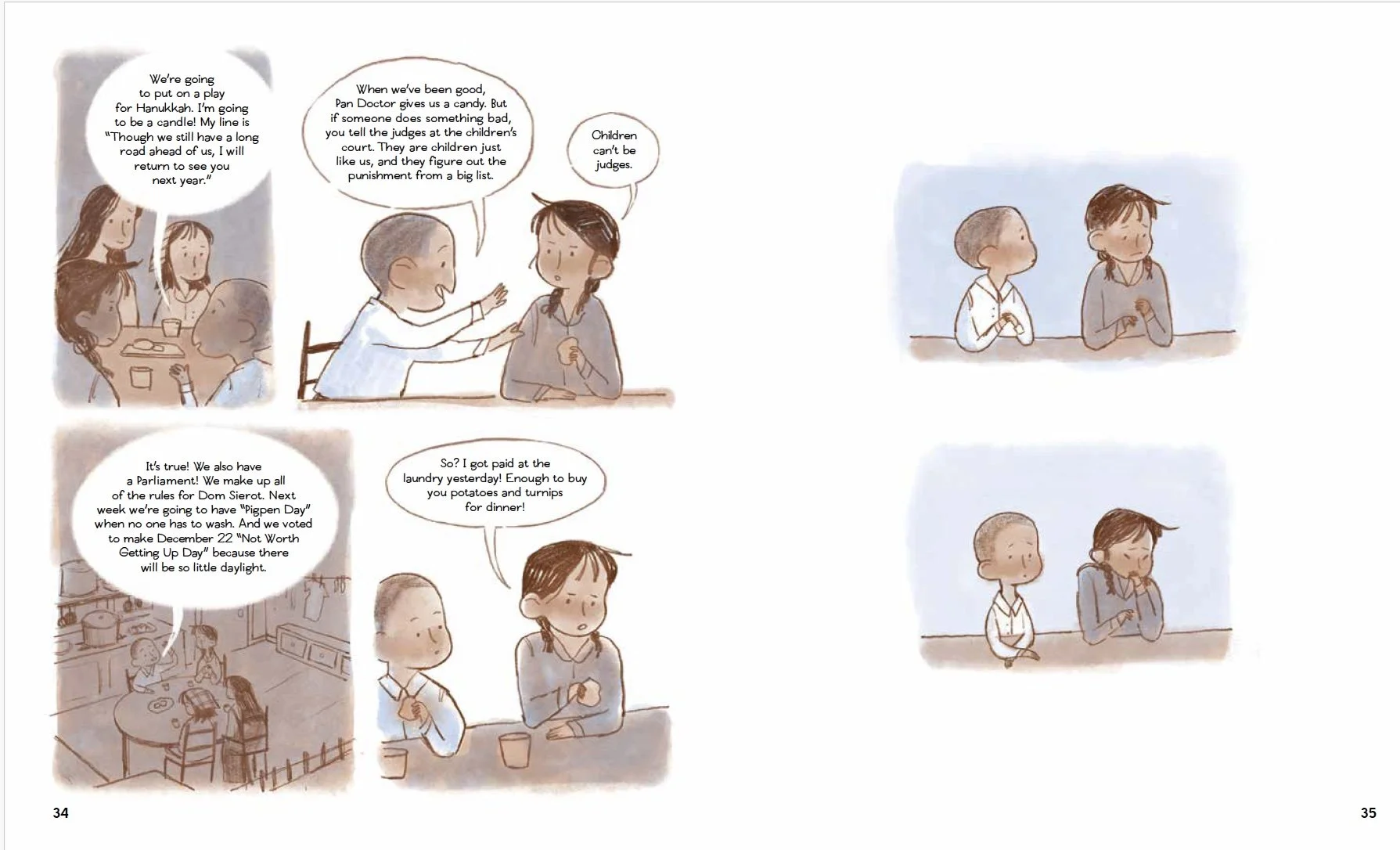
Finished artwork, pages 36-37. Izaak is talking a mile a minute to his sisters about his exciting new life in the orphanage. His sister silences him with a dose of her own reality. He is ashamed and embarrassed by his self-centredness. The feeling is reinforced by having two closeup panels with lots of white space around them. ©Amanda West Lewis & Abigail Rajunov
From theatre workshop to scripted play, from middle grade biography to picture book biography to graphic novel –– there are many different containers for stories, and each container changes the nature of the story. As a writer, I, too, am changed with each different container. The process stretches me and helps me to discover what I really want to say and why it was important to say it. Writing the story as a graphic novel has allowed me to finally tell the story I needed to tell. Korczak’s life is overshadowed by the horror of his death in the Holocaust. But I found a way to remind people of the positive power of his ideas. And I found a way to end on a positive note.
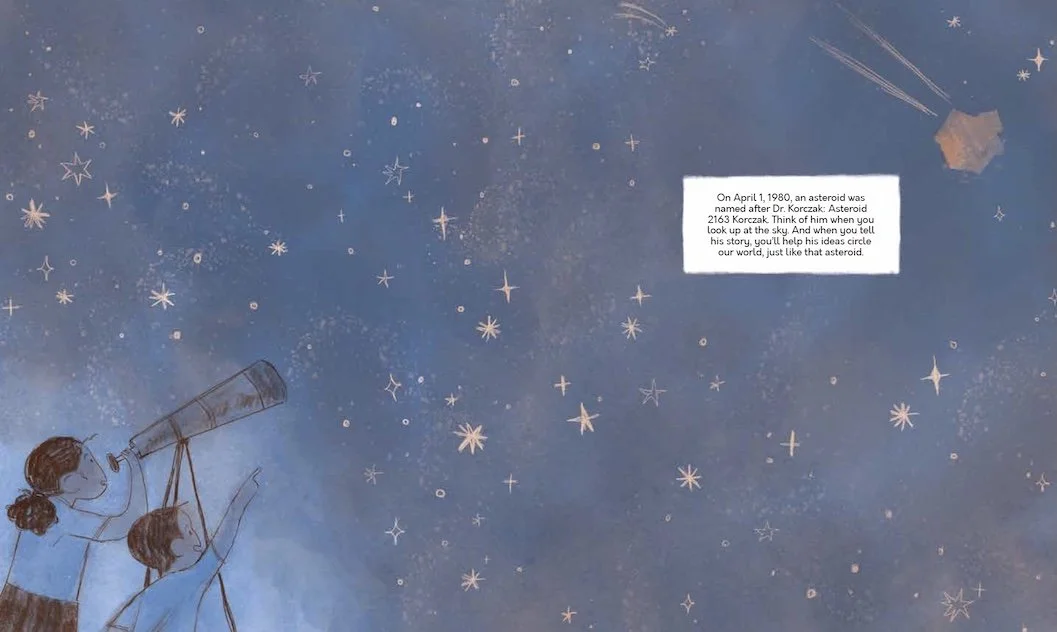
“On April 1, 1980, an asteroid was named after Dr. Korczak: Asteroid 2163 Korczak. Think of him when you look up at the sky. And when you tell his story, you’ll help his ideas to circle our world, just like that asteroid.” © Amanda West Lewis & Abigail Rajunov
There’s such a dance here between words and images. I saw The Children’s Republic when it was produced in Victoria, BC, in 2017. Remembering the play, I can feel its connection to these pages. It seems to me that every step in this book’s journey left a mark on what it finally became. Thank you, Amanda, for all the careful choices you made in this tribute not only to Korszak’s life and the lives of the children he cared for but also to the hearts and minds of your young readers, “the people of today.”