Guest Post: Suma Subramaniam on the V. Malar Series
Writing the Book Uncle trilogy was a recursive process for me, as I had to go back and read the first book, pretending to be that new, naive reader demanded by revision. I sketched characters in small increments, then let them surprise me as their stories braided together. I became curious about how other writers approach the work of turning a single book into many stories. How do you do this in a way that respects young readers’ intelligence without condescension? Rewriting was where the trilogy found its shape: I pruned sentimentality, sharpened dialogue, and tried to make space for humor and everyday grace.
I read Suma Subramaniam’s first V. Malar book with particular pleasure on account of its setting. It is the precise rural counterpart to the urban setting of my Book Uncle books. I could see these characters talking to each other. I could see my little trio of friends finding themselves enlightened and challenged by the very same forest camp where young Malar finds herself.
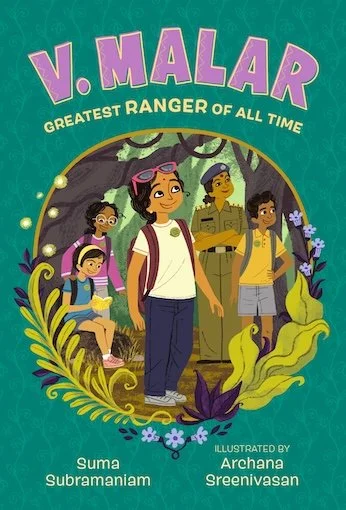
So I’m especially delighted to welcome Suma back to talk about writing her second V. Malar book, V. Malar, Greatest Ranger of All Time.
Making V. Malar a Series
Suma Subramaniam
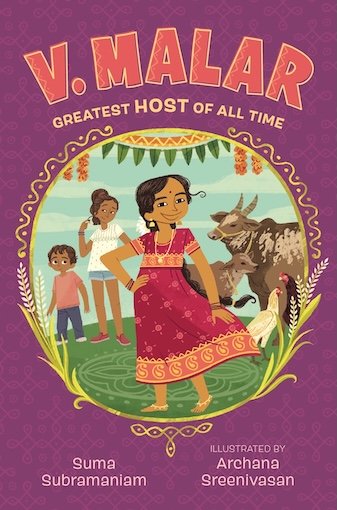
I envisioned the first V. Malar book as a picture book with the premise of a girl exploring the harvest festival of Pongal in her grandparents’ village in South India. However, when I shared the manuscript with my beloved cohort from VCFA, they asked me lots of questions. Why were certain rituals followed? What it is like to draw those beautiful rice-flour designs outside, on the thresholds of homes? And plenty more. As I started responding to the questions, the story became longer. I realized that what I was doing wasn’t just answering questions for readers on the outside of this place and culture. I was making room for this character to grow. Malar could take on new challenges in more than one story, and I began to see what those might be. Slowly my picture book idea transformed into an early middle-grade/chapter book series of three.
So there you have it! I created V. Malar as an episodic series where she could be a strong protagonist that readers can’t help falling in love with. In each book, Malar has a different goal. I made a list of all her adventures and sprinkled them over several book ideas so each story in the series could be read as a self-contained standalone book, but it also builds through the series.
My writing and research process was different with each book, based on its needs. I’m grateful to my editors, Kate Fletcher and Ananyaa Malhotra at Candlewick Press as well as my agent, Miranda Paul, who were okay with longer turnaround time than is usually allowed for a series. I had the flexibility to travel for research, do tons of side writing exercises on character and voice, and work on the writing craft.
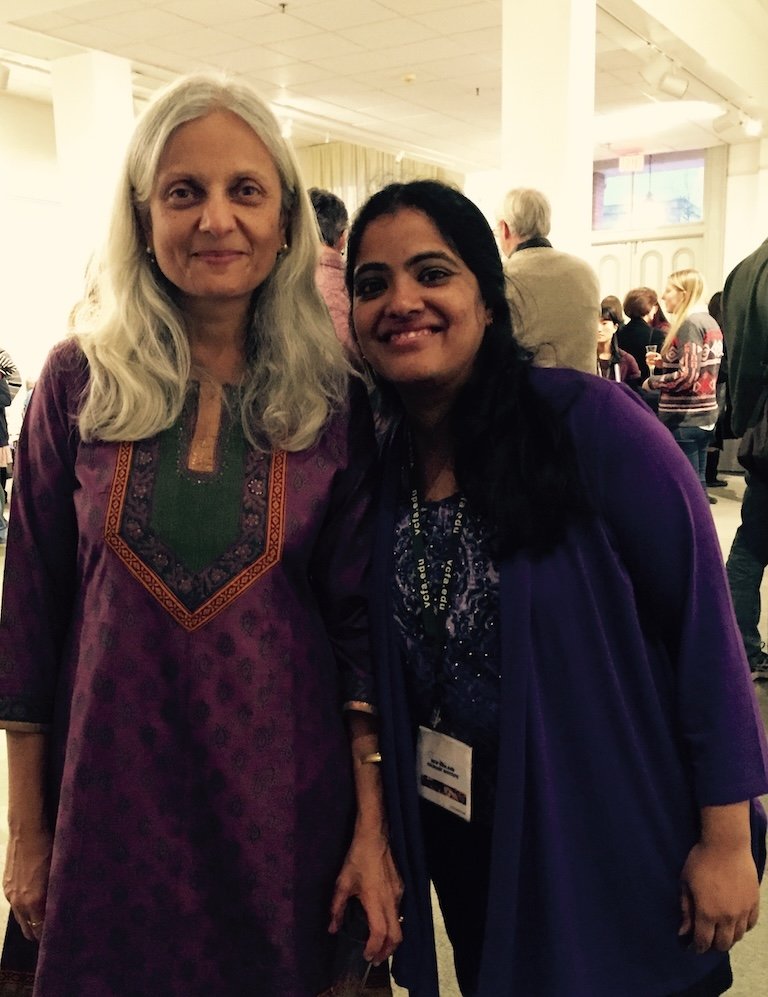
Suma and me at VCFA residency, 2016. Photo courtesy of Suma Subramaniam
For the first book, I tapped into my own family traditions. Malar’s coastal village was inspired by my husband’s native village in the South Indian state of Tamil Nadu. I took many notes. I had conversations with elders. I revisited the rituals connected to Pongal, the harvest festival of Tamil people. For the second book, I traveled to the rainforests in the Western Ghats of South India and interviewed conservationists and rangers to experience Malar’s journey. For the third book in the series, Greatest Hallowali Of All Time, which releases in 2027, I interviewed second generation immigrant and diaspora kids about their Halloween traditions, as well as the cultural conflicts and identity-related issues they’re navigating. Illustrator Archana Sreenivasan also brings forth a lot of artistic details that are both consistent through the series and distinct for each book. Because she has lived experience similar to Malar’s, I didn’t have to explain or write art notes.
Unlike some traditional chapter books, I chose to move beyond cookie cutter choices. I tried to avoid formulaic character portrayals. I didn’t gloss over relationships that Malar develops. I wanted Malar to have deep emotional connections with her family and friends in every story. These connections are carried forward in multiple books. For example, Malar and her cousins reunite in the third book when she visits them in Seattle.
“Working on the Malar series changed me as a writer. It pushed me to slow down and research harder. I learned to trust the long process and let the rewriting and revisions lead the way. ”
The series touches on themes like sustainability, intergenerational relationships, diaspora struggles, climate change, conservation, culture, divorce, and many others. These social issues don’t take the forefront, but are portrayed within the milieu of characters that appear in every story. Poetry played an important role in shaping these stories and getting the emotions on the page. My MFA mentor, Martine Leavitt, advised me to read a poem every day before I start writing. For the first book, I attended a verse novel workshop by Cordelia Jensen. For the second book, I attended a South Asian poetry workshop by Shankar Narayan. For the third book, I attended another poetry workshop by Shankar Narayan about the raga of rhythm and exploring sound in poetry. Writing with a lyrical voice gave Malar the complexity to grow and evolve through the course of the series, leading readers to a satisfying ending and an urge to read the next book.
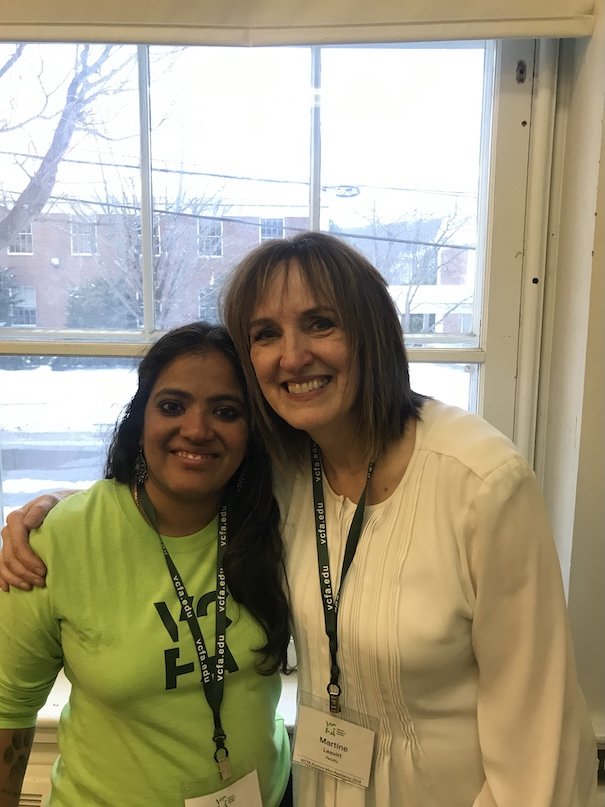
Suma with Martine Leavitt, 2016. Photo courtesy of Suma Subramaniam
When readers dive into Malar’s world, I hope they find joy in noticing familiar themes. For instance, in book one, Malar’s big challenge is getting along with cousins from the opposite side of the hemisphere and making them comfortable in her village home. In the second book, Malar dreams of becoming a nature conservationist, but when she wins a weekend at an animal reserve in the Western Ghats of South India, she learns about the challenges of the habitat, and what it takes to live on her own in the wild with fellow campers she has never known. The valuable SEL and STEM lessons in these details pay off even though the story is set in Malar’s new world and her challenges change things up.
In my school visits, children come up to me to say they’re excited about reading her again and again. Malar has become a memorable character with emotional layers peeling out in her adventures set in the modern contemporary world. I’m delighted that kids find her realistic and believable. She makes a lot of mistakes along the way and learns powerful life lessons.
Working on the Malar series changed me as a writer. It pushed me to slow down and research harder. I learned to trust the long process and let the rewriting and revisions lead the way. Malar gave me the gift of experimentation with this series, and I hope she gives that same gift, of an open mind and heart, to every reader who steps into her world.