Imagined History in Philip Roth’s The Plot Against America
The Plot Against America is driven by its alternate timeline in which Charles Lindbergh runs against Franklin Delano Roosevelt, who’s seeking a third presidential term. The unthinkable happens. Lindbergh wins and the lives of the book’s Jewish narrator and his family begin to unravel. In the context of an ordinary neighborhood in the Newark suburbs, the real-world timeline of history is twisted into imagined ones.
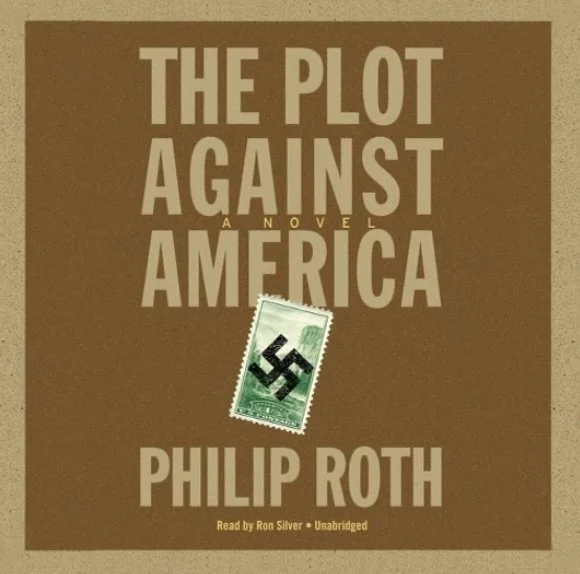
There’s another powerful twist here. The narrator not only bears the author’s name but is a fictionalized version of himself. And that, right there, is a craft choice that places the reader on a tightrope of truth, swaying over canyons of invention in a story that is all about trying to figure out the truth in a world overwhelmed by falsehood.
Think about it. Imagine writing a novel in which you place yourself, your own child self, and your own family, neighborhood, community. Brush them with fiction. Give yourself license to invent elements of their characters, leaving some aspects unchanged. Additionally, take a single storyline from the real history of the time and invert it so thoroughly and brutally that its weapons become trained upon that family, at once your own and not. It’s an awesome, frightening feat of imagining.
Example:
I pledged allegiance to the flag of our homeland every morning at school. I sang of its marvels with my classmates at assembly programs. I eagerly observed its national holidays, and without giving a second thought to my affinity for the Fourth of July fireworks, the Thanksgiving turkey or the Decoration Day double-header. Our homeland was America.
Then the Republicans nominated Lindbergh and everything changed.
In short, Lindbergh runs as the “peace candidate” against FDR in the 1940 elections. He campaigns on a platform of fearmongering that trades on the insecurities of a large section of the population—and guess who the voters send to the White House.
“It is easier to comprehend the election of an imaginary President like Charles Lindbergh than an actual President like Donald Trump. ”
In 2004, the year this was published, we could read the book through the lens of Simon Wiesenthal being awarded a knighthood, or the campaign against John Kerry that propelled a newly minted phrase into our discourse. It was a rousing cautionary tale but its vision looked back on the past. It was possible to move on, and in fact, America had moved on—right?
Turns out, not so much! Think of America First, a loaded rallying cry that either draws or repulses a listener. Lindbergh formed an America First committee, decades before the phrase was lifted and meme-ified by the current occupant of the White House.
Read in book form, e-book or hard copy, or heard in the audiobook version, narrated with emotional depth by the late Ron Silver, The Plot Against America spins its story like a creepy but weirdly familiar dream. As its events unfold, ordinary people all around young Philip’s family stand by and do nothing, or worse, collaborate enthusiastically with the descent into Fascism of the Lindbergh administration. A final plot twist shifts everything. It had all been a great and tragic anomaly. The good news was an ending in sight, a chance to heal at least partially.
It left me steeped in a kind of anticipatory longing for such a plot twist in the real world we’re in now—one that could somehow, if not set everything to rights again, at least offer a path forward.
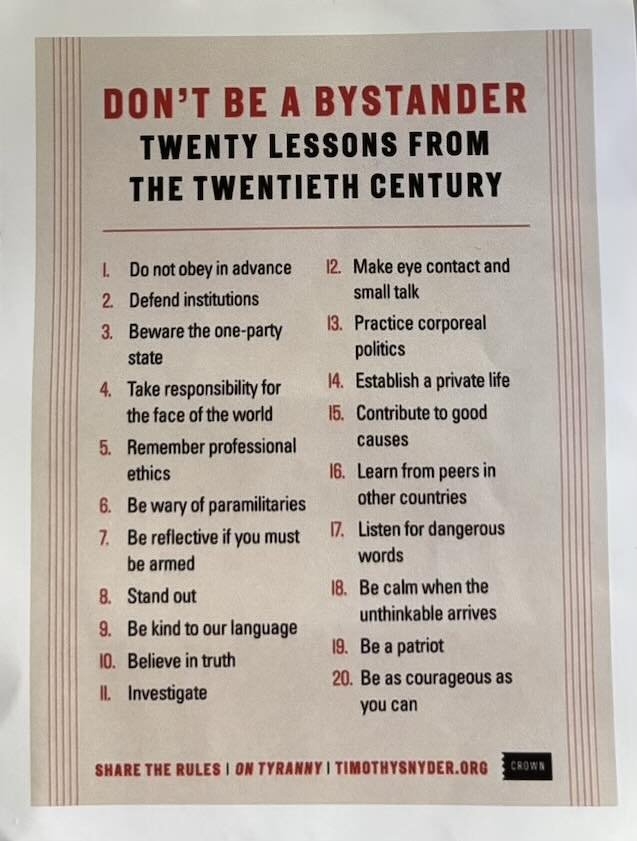
From chapter openings in On Tyranny by Timothy Snyder.
Roth, who has retired from writing, has talked about the uneasy parallels his novel summons up between history and fiction, history and the present. Here’s a snippet from an email exchange with Judith Thurman of The New Yorker:
“It is easier to comprehend the election of an imaginary President like Charles Lindbergh than an actual President like Donald Trump. Lindbergh, despite his Nazi sympathies and racist proclivities, was a great aviation hero who had displayed tremendous physical courage and aeronautical genius in crossing the Atlantic in 1927. He had character and he had substance and, along with Henry Ford, was, worldwide, the most famous American of his day. Trump is just a con artist. The relevant book about Trump’s American forebear is Herman Melville’s ‘The Confidence-Man,’ the darkly pessimistic, daringly inventive novel—Melville’s last—that could just as well have been called ‘The Art of the Scam.’ ”
Reading makes us witnesses to the events in a work of fiction, where we can imagine ourselves, feel ourselves immersed in great writing, and emerge in a daze to get on with our ordinary lives.
Real life, in contrast, calls on witnesses to do something. If we want that path forward, we can’t afford to be bystanders.