I wrote about This is a Door (I read it in e-galley form) back in July when doors of all kinds were on my mind. Here’s part of what I said back then:
I’d really enjoyed Nayeri’s autobiographical Everything Sad is Untrue and lost myself in the combination of fabled setting and ripping good storytelling in The Many Assassinations of Samir, Seller of Dreams. This one’s as dazzling in its own way.
After writing that post, and reading Nayeri’s PW interview, I invited Daniel Nayeri to trade an email or three with me about the book. I’m delighted to share the resulting conversation.
[Uma] You’re riffing on the hero’s journey, but your Ing is also just a kid—not your typical hero, at least to begin with. In what ways do you think you were using the template while also writing against the archetype?
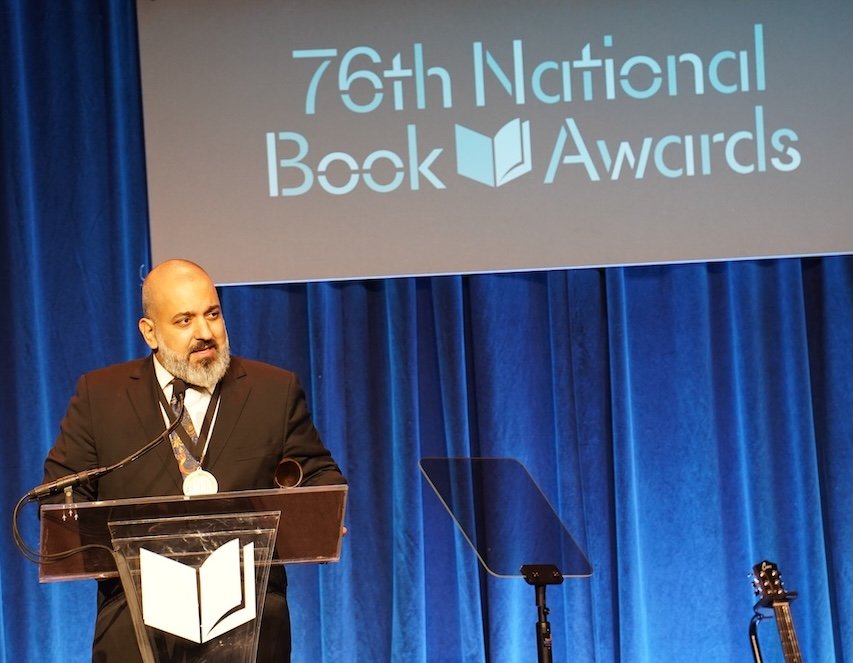
By Jennifer 8. Lee / WikiPortraits, CC BY-SA 4.0. In 2025, The Teacher of Nomad Land won the National Book Award in the category Young People's Literature.
[Daniel] I have a process in my thinking called, "yeah but what if I loved it?" It's something I do when I find myself instinctively hating something...say, a genre of music, a city, or a piece of art. It's like a failsafe. I'll indulge myself in hating the thing, then ask, "yeah, but what if I loved it?" In this case, it was the concept of the Hero's Journey that irked me while I was working on a creative writing book called HOW TO TELL A STORY. When you're writing an instructional book, you're always contending with the feeling that you don't want to lapse into pat answers, or formula. But you only have so much space, and you need to offer some proscriptive advice, and the Hero's Journey haunts the entire endeavor. So, as I was working on that project, I kept asking myself, "What if, instead of thinking of the Hero's Journey a cliche machine, I gave it the opportunity to inspire something?" It was there that I started to hear the voice of Ing, who is in many ways a generic boy, and in a few others a person I have never met before.
[Uma] "What if I loved it?” Really? Most of us spend time and energy defending the likes and dislikes we've come to own. You’re pushing back against your own instincts. Can you tell me what made you start doing this in the first place (not necessarily with the hero’s journey)?
[Daniel] When I was a publisher I used to tell my editors that their jobs were to be "professionally curious people," which was to say that the role was not simply to buy every manuscript in the narrow band of topics they already liked. In fact, I tend to think that it's often helpful when an editor works on a project in a topic, category, or format with which they're not overly familiar. They often ask the questions that drive the project in new and innovative directions. But to do that, they have to be enthusiastically in love with the idea, not simply ushering the project through the publishing process. I remember feeling annoyed at the coloring book trend during those years. My boss was pushing for our team to jump on the bandwagon and I was resisting. Eventually, I went home one weekend and asked, "What if I loved it? What kind of coloring activity would I want to do?" When I got back, I had the nugget of an idea that our team turned into Paint By Sticker, a series that carved out a whole new category. Of course, sometimes you try something on for a moment and you're confirmed in your initial distaste, and that's fine too. I suppose it's just a way for me to double check my reactions.
[Uma] There’s a life lesson in there, but back to writing. Where in the process did the story’s heart really kick in for you?
[Daniel] I like things organized neatly, so it's always a temptation for me to round out a cast by making sure that each character brings something new. This is the sort of thing that works in folk tales, where a duo might be "the one who always lies" and "the one who always tells the truth," or an anime where each character represents an animal and a color. When I start to think about a trio like Ing, mOmO, and Pöppy, I often start there... “this one's the smart one, this one the silly one,” etc. But that's not how things always work. You might have an entire ship of goofballs without a single wise character, or a trio of dunderheads. I tend to know I've got the heart of the story when I don't think about the characters as the purpose in the story, but as individuals.
[Uma] Which brings us to Ing. You write his character with great affection, even when you’re getting ready to have awful things happen to him. What do you love most about this kid?.
[Daniel] I heard about a study once that I'll paraphrase here (probably incorrectly). The study purported the value for kids entering the 6th grade to have something, anything, that they consider themselves good at. It was a study on confidence, and said basically that every kid in that period of life when our identities are so fragile, needs something to latch onto. And the fascinating part was that it really didn't matter how substantive the skill was. The kid who was the best at applied mathematics was just as likely to find confidence as the one who was best at animal noises. Unfortunately, it also meant that kids who couldn't point to anything were more likely to have a hard time in their new middle school environment. I think of Ing as one of those kids, and I want nothing more for him than to find something he's good at.
[Uma] Tell me more about how this book came out of your craft book/game/collection of exercises, How to Tell a Story. You were writing examples for voice and dialogue, I know, but what prompted the leap into concrete poetry?
[Daniel] How to Tell a Story is the type of writing instruction book that puts your pen to the page from the start. I tend to believe that a day of practice is better than a month of dreams, so it's full of creative prompts, along with examples for the chapters on the constituent parts of storytelling such as conflict, motivation, dialogue, etc. As I was working on it, I thought, wouldn't it be fun if I could create my example writing from a shared world, rather than random snippets? It started with a passage about a feral girl trapped in a ghost market and a shy boy who meets her one day in the forest. And the rest built out from there. As for the concrete poetry...well, if I was going to be so traditional as to walk along the Hero's Journey in the content of the story, then I thought I could at least try some experimenting in the form.
There’s a playfulness to This is a Door that reminded me of the abecedarian element in The Neverending Story by Michael Ende or the rhyme and reason duality in Norton Juster’s The Phantom Tollbooth. Like those books, this one too turns structure into play, as children instinctively do with life as they encounter it. Thanks to Daniel Nayeri for this interview and for this delightful book.