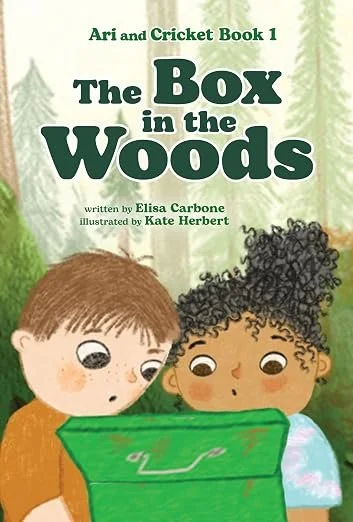
Elisa Carbone and I were together in a writing group in Maryland long ago—back in the last century, in fact—along with author-illustrator (now fine artist) Sally J. K. Davies. So I was pleasantly surprised to hear from Elisa again, after she read something I’d posted on an Author’s Guild online forum. It turns out Elisa is writing a series of middle grade chapter books, the first of them out this year, featuring two young characters, Ari and Cricket. Naturally, I asked for an e-galley which the publicist at Reycraft Books kindly sent along.
Benchmark, of which Reycraft Books is an imprint, is an educational press, so these books dance along that fine line between pedagogy and entertainment. The Box in the Woods (Ari and Cricket, Book1) is driven by a combination of STEM themes and the energy and enthusiasm of its pair of fictional young amateur sleuths.
“For me, stories and characters have a life of their own and they frequently surprise me. ”
In addition to Ari, whose bent of mind is distinctly scientific, and Cricket, who is brilliant at math, the slim little chapter book is peopled by a host of funny, eccentric adult characters whom the kids have to report to, satisfy, duck, or otherwise consider along the way—Grandma Leah and Papaw with their paragliding, Cricket’s dad caught up in his own kind of bug world, Ari’s mom routinely assigning tasks related to science experiments, and GiGi who used to be a NASA computer. The problem the young sleuths have to deal with is that of the dying goldfish in a neighbour’s pond. Between them, and with sometimes unwitting help from their families, they follow the results of a series of experiments to crack the case. Pages turn quickly, dialogue snaps along apace, and in the end, we’re left poised on the brink of the next mystery to come.
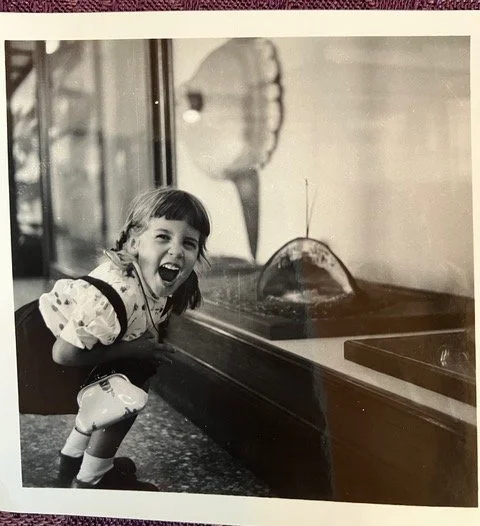
Elisa (5) at the Smithsonian, Washington, DC, sometime in the last century. Photo courtesy of Elisa Carbone
Here's my conversation with Elisa Carbone about Ari and Cricket, the STEM-filled world they live in, the problem they set out to solve, the eccentric adults they’re surrounded by, and more.
[Uma] The Box in the Woods opens a series featuring your characters, Ari and Cricket. It promises a partnership to come, consisting of STEM problem-solving with a light touch of sleuthing driving the story. What led you to this particular combination?
[Elisa] What is it that brings any story into being in our imaginations? For me, stories and characters have a life of their own and they frequently surprise me. I have spent decades writing stories that had to follow true historical events at least in part. With this series, it has been a real treat to go back to writing contemporary humorous fiction, like I did more of in the past. Maybe it was the influence of writing about real people for so long, but these books are actually about real people as well. I stuck my whole family in there! Ari and Cricket are patterned after my grandkids, and I started writing these books when they had just started school. They excel at science and math, and neither of them is into reading at all. So I knew I had to write about things that would interest them--animals, science, math, gross stuff, funny stuff, and sleuthing.
[Uma] The adult secondary characters are all larger than life. Tell me how your kid characters ended up with these adults for company and tell me how you see their roles emerging in successive books.
[Elisa] They ended up with these adults because they are with them in real life! The adults are patterned after my kids and their spouses, my husband and myself, and my mom. I love it that when the illustrator drew my mom (GiGi), in Ari and Cricket Book #2: Orange or Blue (April 1, 2027) she got her hair exactly right. Of course I never said anything, just the power of imaginations meeting in the ethers.
My husband and I actually do the extreme sports that Papaw and Grandma Leah do—windsurfing, rock climbing, kayaking white water.
Where are we headed with these characters? There will definitely be more experiments for Ari’s mom to do with the kids. I’m keeping the experiments simple so that they can be easily replicated at home or in the classroom.
The dads I think are the straight men in the midst of the kids’ antics. Ari’s dad goes through an unfortunate underclothing event in Book #2, and Cricket’s dad is the unsuspecting, math quizzing chauffeur to some wild shopping mall mischief in Book #4 (Spring, 2028).
One place I want to take readers with Cricket’s mom, in book #5 (in process), is an evening when she is heading out to give one of her classical piano concerts that she practices for all the time. This is where a bit of my own life comes in. I’m a blues/ragtime/jazz pianist and I gig out with my band—we offer an historical storytelling musical performance, appropriate for school groups. I think it will be fun to write about that “on my way to a gig” time.
[Uma] I’m surprised and amused to find my last name bestowed upon an affable man with a fish pond in his back yard. Will we see him again, do you think?
[Elisa] More real people! Sorry my imagination turned you into a man, but I loved having the chance to honor you, my writing critique partner from back in the beginning when we were both starting out, and one of my co-authors along with Rukhsana Khan of Many Windows. Yes, I’ve outlined book #5 and Mr. Krishnaswami himself is back.
[Uma] Grand. I still get the occasional email about from kids or parents about that book. Finally, one mystery—the one framing the series, of who’s placing messages for the kids in the box--doesn't get resolved here. How do you think you’ll let that play out in successive books?
[Elisa] The mystery continues, with hints in Books #2, #3 and #4 coming from unexpected places. I have not decided when to totally reveal that mystery for readers.
[Uma] Elisa, it sounds like so much fun to plot these loosely as a whole and then tighten the winch, so to speak, with each book. Congratulations and thank you for this conversation!
Note: Elisa writes a Substack, About the Farm, described as “the true story of how an older landowner connected with young farmers to create both a market garden and a timber investment, and make everyone's dreams come true.” Here’s a snippet:
Invasive species are opportunistic and self-preserving, and so is the rest of nature. Sometimes, as in the case of the American chestnut, all the trees of a particular species do die. But other trees take their place.
As one part of this web of nature, we have farmers, eradicating destructive invaders when they can and changing crops when necessary. It is a dance that requires creativity, ingenuity and hard work in order to continue to produce the world’s food.
The good news is, we are still dancing.
That is good news, indeed. Thank you, Elisa Carbone—it’s very nice to reconnect with you after many years and to talk about stories and characters once more.