Process Talk: Karthika Naïr and Joëlle Jolivet on Electric Birds of Pothakudi
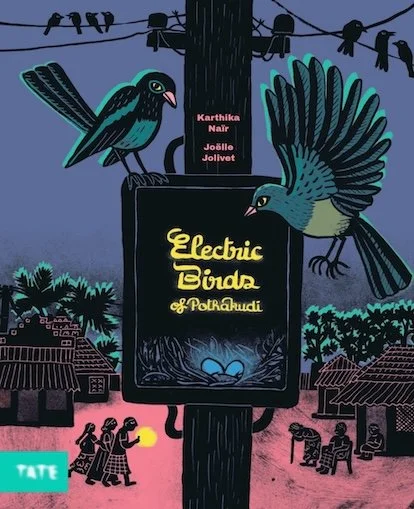
Electric Birds of Pothakudi is a picture book based on the true story of a villager in south India who took extraordinary action to protect a pair of nesting birds. It’s a strikingly illustrated book, in a bold mix of manual and digital work, with a palette that ranges from brooding to brilliant. I’m continuing my conversation with author Karthika Naïr, and also, I’m happy to add, looping in illustrator Joëlle Jolivet. Karthika kindly sent me several page scans scans from the French edition of the book, which I’m happy to include here as well. It’s always wonderful when a book finds expression in more than one language.
“...all of this is really a long-distance reconstruction, and I wanted to be transparent about that even within the story...”
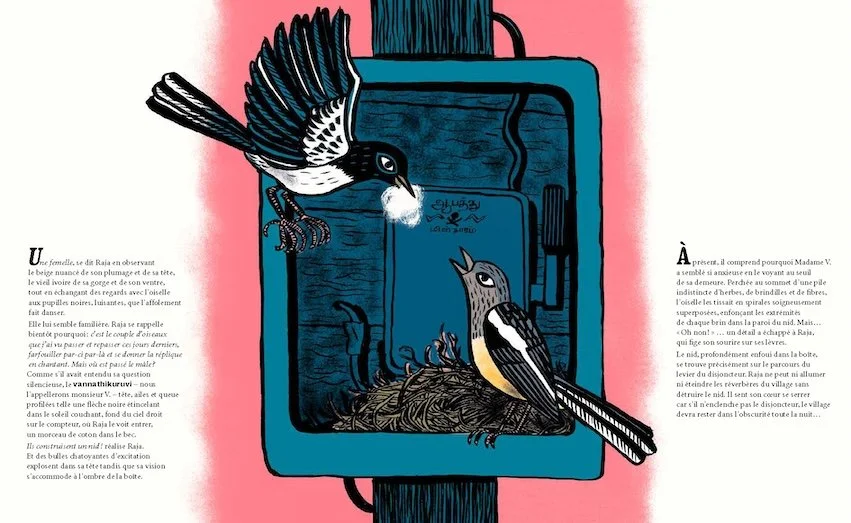
Interior spread from Oiseaux Électriques, the French edition of Electric Birds
[Uma] Karthika and Joëlle, what was the best part of working on this book and were there any challenges that stand out to you?
[Karthika] As is often the case, the R&D time, first prior to the discovery of the Pothakudi news report when my non-treatment days were filled with reading and watching amazing accounts from all across South Asia—of the living root-bridges in Meghalaya, the swimming camels in Kutch, the ‘Tiger Widows’ in the Sundarban trying to save the Sundari tree… A bevy of inspiring stories about the people immediately affected by climate change and damage to the planet. And, once we had decided the book would be about Pothakudi, the time spent documenting everything about Pothakudi, its flora, the layout of the village, the demographics…
As for challenges… Since the book was written during the Covid-19 pandemic, all of it was written long-distance. I mean, I have been to many parts of Tamil Nadu many times since childhood, but never to that particular village. So all of this is really a long-distance reconstruction, and I wanted to be transparent about that even within the story, which is why the parent warns Peanut that the news report Uncle Doony sent is very short, and they’ll have to “dream up a full-fledged, magical, story for you out of those ten lines now.”
[Joëlle] I was so happy to rediscover the joy and freedom of painting and to see our characters come to life.
As usual, time is the main challenge... I'm always running late and watching the deadline approach with anxiety, but it's also the motivation that pushes me to create!
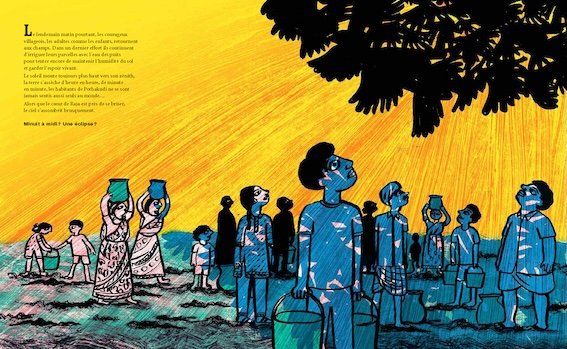
Interior spread from Oiseaux Électriques, the French edition of Electric Birds. All page scans courtesy of Karthika Nair
[Uma] Joëlle, can you talk about the process of creating the art for this book?
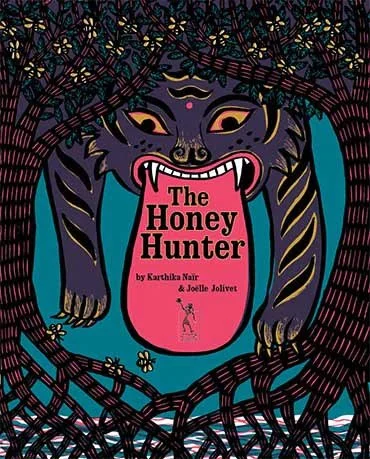
[Joëlle] Unlike most of my previous books, neither The Honey Hunter nor Electric Birds were created using linocut. It’s a mix of techniques; I drew with brushes and added textures with monotype. Everything is drawn in black, then scanned, and some elements became colored directly on the printing channels in the computer. The book is printed with 5 spot colors: blue, yellow, pink, turquoise green, and black. I chose this technique to capture the stunning colors of South India—the shiny green of landscapes, the clothing, and the interiors.
I was particularly struck by the contrast in the landscapes between the green of the vegetation and the pink of the earth.
[Uma] The details of your artwork are wonderfully intricate—the “danger” sign inscribed in Tamil inside the switchboard, the birds and houses and people creating a sense of a bustling community. And the people in the art—their clothes, gestures, expressions, fhe variety of faces and forms—are at once stylized and yet completely recognizable to someone who knows the setting. Can you talk about the cultural borders you’ve navigated in this work?
“I try not to be caricatural or essentialist. ”
[Joëlle] I’ve been to India several times, mainly to promote our books, so mostly in big cities. I spent some time in Chennai, where I worked on a book about the life on the beach with Tara Books.
I try not to be caricatural or essentialist. I enjoy observing and drawing people; I’m interested in artistic expressions as well, and I try to understand them and immerse myself in them so I can express how a place makes me feel.
Unfortunately, I didn’t have opportunities to visit the countryside, so to figure out Pothakudi, I had to settle for traveling virtually on the internet, but it’s easier to find things when you already know a little about the context… and of course Karthika helped me a lot in my quest of images. I feel like I know Pothakudi almost as if I'd been there myself! But I would love to go there in real life !
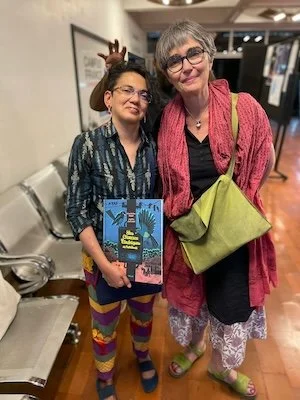
Karthika and illustrator Joëlle Jolivet in Bengaluru, 2023. Photo courtesy of Karthika Naïr
[Uma] What’s your favourite spread in the book and why?
[Karthika] It’s a tough choice, because Joëlle has outdone herself and there are many breathtaking pages. But my favourite has to be the night scene in the middle of the book, done entirely in black and indigo and white, which looks like a scene from a puppet-theatre play, which strikes me as an apt homage because Joëlle was looking closely at Tamil and Keralite traditions of shadow puppetry like tholpavakoothu. I love the combination of economy of colours and wealth of detail, the pulsating deep blue of night, and the sense of both movement and stillness it conveys.
[Uma] Joëlle?
[Joëlle] I think my favourite is this one as well! For the same reason...I've really been thinking a lot about shadow puppets.
[Uma] Without knowing any of this, I was struck by how much your art evokes the lines but also the movements of shadow-puppetry. I don’t get quite how you do that, Joëlle, with static images, but it’s quite remarkable.
Thank you, both of you, for your insights into your process and for the work you have done in elevating the act of compassion at the heart of this book.