Empathy and Breaking the Rules in Cry by Alisa Valdés
I was a part-time cashier in a rare-books store when I died…
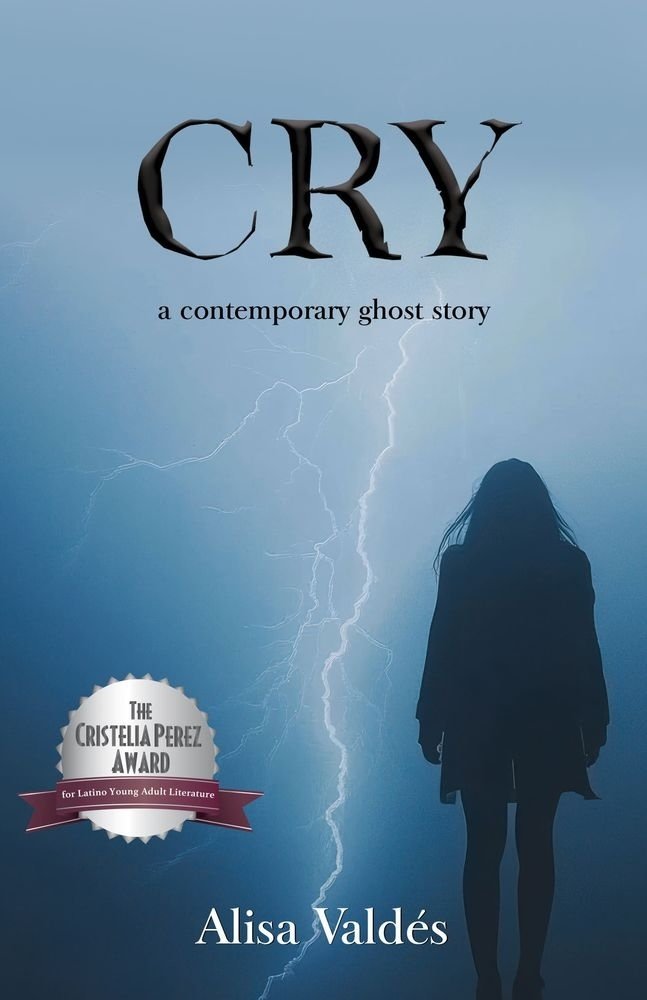
That’s the funny, idiosyncratic voice of the first-person narrator in Cry by Alisa Valdés. Altagracia Martínez (known as Grace) is a 16-year old bisexual goth filmmaker in Austin, Texas. She’s also battling internal demons, on account of having lost her own mother to suicide two years before the story begins. Grace isn’t wild about the “stenchmother” who is her father’s new wife, so there’s plenty of conflict brewing.
Turns out her near-death experience left Grace with some strange perceptual abilities. She can see the dead. When a teen ghost named Mohammad shows up, Grace begins to lean reluctantly into these powers. She finds that small expressions of empathy seem to have healing qualities, even as she gets drawn more deeply into the terrible questions these apparitions raise. She starts to investigate the circumstances of Mohammad’s death, while he communicates with her via retro songs that show up spontaneously on her Spotify playlist. In the process Grace uncovers secrets within her own family as well as those from the past.
Grace’s voice speaks of unbearable things, while somehow managing to make them bearable to the reader, not only because the speaker has crossed into the realm of death and returned but also because she is wryly funny. Before you’re through, and almost before you know it, she’s become a friendly guide through a pretty dark and scary universe, analogous not just to our present, but to historic times as well.

Photo source: Alisa Valdés
Spun through this story of a girl and her relationships is a La Llorona story that has to do with breaking the rules, crossing the boundaries of social acceptance. The mythical figure here represents an even older narrative, of Pakwá-ule, rendered as an ancient, pre-Christian sorrowing woman. But La Llorona, as Grace finds out, is like a mirror to the communities who have historically cast her in their own varied ways, vilifying or glorifying her to suit their own ends.
Among the cast of allies around the first person narrator is Lucía Cabra, Grace’s “girl-space-friend” and garage band-mate, who points out this other story with a New Mexico setting. It’s one of love and betrayal and what were seen as social transgressions in Spanish colonial times. Grace seems to share a mission with this version of La Llorona, the saving of dead people from endless grief and unrest.
Valdés weaves together history and imagination, adding a red herring and a final plot twist to solve the problem of dead and bereft Mohammad. She avoids possible cultural minefields with adept artistic choices, even while refusing to duck complications. Finally, the comeuppance of antagonist Mikaela Hoffmaster, described by Grace as “my gum-smacking, perfect-haired, Ibiza-going, loudmouthed influencer nemesis,” is oddly compassionate in its rendering. There’s a lot packed into this story but it’s all interesting, well-turned, and delivered by a writer with fire in her heart.
Winner of Arte Público’s Cristelia Pérez Award for Latino Young Adult Literature. Reads well in tandem with Ann Davila Cardinal’s The Storyteller’s Death.
From Alisa’s website:
Alisa Valdés-Rodriguez (also published as Alisa Lynn Valdes in suspense and Alisa Valdes in YA) is an award-winning novelist, journalist, screenwriter, and educator. She is the New York Times and USA Today bestselling author of fifteen books, with more than a million copies in print in eleven languages worldwide. Her debut, The Dirty Girls Social Club, became a cultural phenomenon that redefined Latina representation in fiction. Her most recent novel, CRY, won First Place in the Cristelia Pérez Awards for Young Adult Fiction and earned a starred review in Booklist. Her popular Substack newsletter, ALISA WRITES, has reached No. 1 for literary publications.
She has a devoted following on Substack, with posts that are personal, political, journalistic, writerly, and always filled with passion and conviction.