Process Talk: Karthika Naïr on Electric Birds of Pothakudi
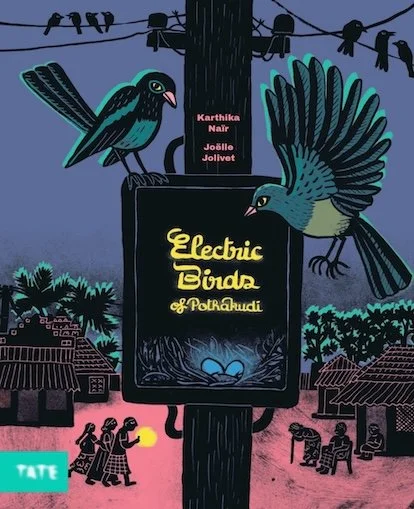
Electric Birds of Pothakudi is a picture book based on the true story of a villager in south India who took extraordinary action to protect a pair of nesting birds. The book is an ode to its rural setting as well as to an act of compassion and really, you can’t disentangle the two. The titular birds (oriental magpie robins for all you English-speaking birders), are known in the region as vannathikuruvi. The name derives from the Tamil word for a person who washes clothes on a riverbank or lakeshore, as flocks of these passerine birds are seen in such places. Bird names in southern India are not only colloquial but utterly embedded in the landscape and somehow this story manages to capture that essence.
The moment I saw Electric Birds… in an e-galley, I knew I’d want to chat with its author, Karthika Naïr, who has roots in Kerala, childhood connections to Tamil Nadu, and now lives in France. A few emails and several months later, here’s that conversation. Wide-ranging? Yup—think pandemic, serious illness, a newspaper clipping, the power of young people’s persuasion, and more. Joëlle Jolivet’s mix of manual and digital art is really powerful and also manages to be whimsical and playful. Karthika, welcome to Writing With a Broken Tusk.
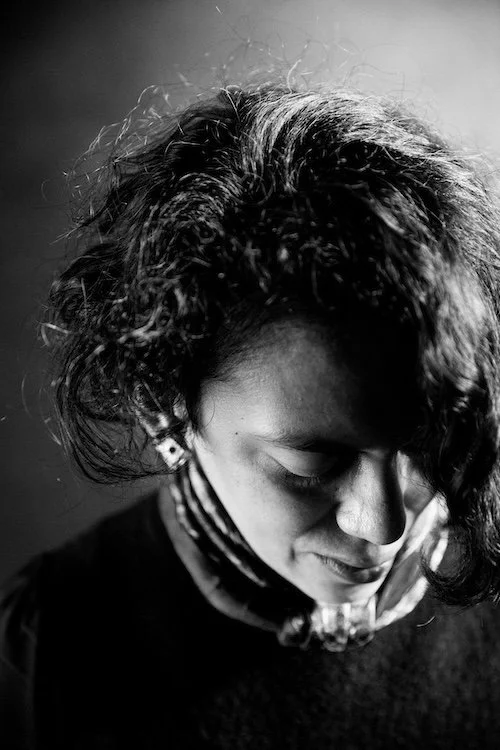
Karthika Nair: photo © Koen Broos
[Uma] Karthika, your story’s had quite a publishing journey—published in France in 2022 and then in an English edition in 2025. Can you talk about this journey and what this story means to you?
[Karthika] Long answer, I should apologise in advance!
The journey began in the spring of 2020 and the first phase of the Covid-19 pandemic: I was caught in a triple-whammy of surgery, chemo and radiation, for a recently diagnosed carcinoma. That was when Sophie Giraud, publisher at Éditions Hélium (who also brought out Le Tigre de Miel — The Honey Hunter in English—in 2013, Joëlle’s and my first collaboration) reached out. She said that one way to alleviate the acute pain of the treatment, and all the uncertainty around low immunity in the thick of the pandemic, would be to get creatively busy. She suggested we do a series of illustrated books much like The Honey Hunter, set in the Indian Subcontinent with all stories grounded in ecological issues. It was a wonderful gesture of solidarity and sisterhood, and cheered me immensely!
So there I was, trying to choose between myriad possibilities of invented eco-fables when a dear childhood friend (who becomes “Uncle Doony” in Electric Birds…) sent me a short newspaper clip, from one of the national dailies. It reported the decision of the inhabitants of Pothakudi, a village in Tamil Nadu, Pothakudi, to go without street lights — for 35 nights, finally — because a pair of vannathikuruvi (the species known in the Northern Hemisphere as the oriental magpie robin) had built their nest in the circuit breaker that controlled all the street lamps in the village. For many of the villagers, that was the sole source of light at night. And it had not been an easy decision because there were genuine risks — snakes on dark streets or in the fields, an increase in attacks by armed robbers — increased by a lightless existence: Many of the older people were apprehensive. But the youngsters in the village had convinced them otherwise, and worked to provide nightly patrols to accompany the elders if they needed to step out.
When I shared the report with Joëlle and Sophie, they loved it too. One of the things we loved was how it gently upends the popular narrative of a young generation totally lost in the world of digital devices and social media, unconcerned with the real world. The youngsters of Pothakudi made deft use of a platform like WhatsApp to disseminate information, and mobilise opinion. And they proved they could go without creature comforts to save a single family of birds. It’s an inspiring reminder of the power of community action. It mirrored my own experience — which was, of course, at a small, individual level — through the pandemic: My found family of colleagues and friends, of care-givers in hospital, kept me safe through those two years of successive waves and mutations, through a shortage of masks and no protection. People went well beyond the call of duty or civic responsibility, and I cannot thank them enough for that generosity and care.
And that extended into the making of the book. I remember the times Joëlle drove all the way to the northern end of Paris (she lives in the southern suburbs) to pick me up and take me to her place so I could enjoy a bit of greenery and fresh macarons — and absolute luxury! — in her garden, amidst the fettered-ness of our pandemic life, while we discussed the future Electric Birds of Pothakudi, the visual world and the colour palette.
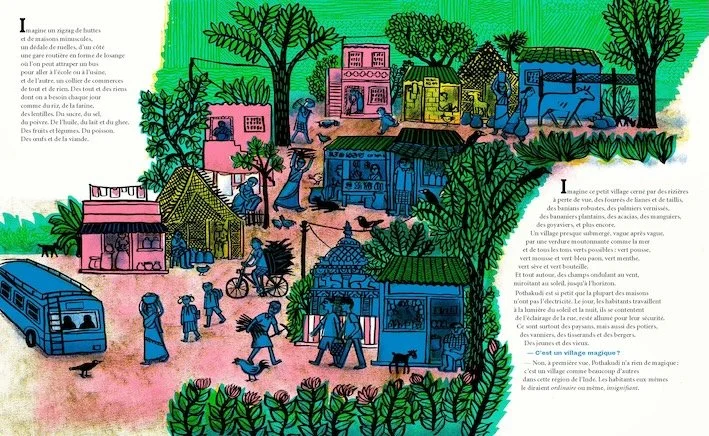
Interior spread from Oiseaux Électriques, the French edition of Electric Birds
[Uma] So many life events, all threaded into this book. I’m intrigued by the narrative choices. Why frame this as a conversation between a parent and child, with the retrospective voice of the adult-narrated story contained in that conversation? What freedom does that layering of story give you?
[Karthika] The conversational narrative framing device is one that I’ve adopted in all my children’s books. I find it can create an organic bridge between worlds, and allow the parent-narrator to introduce an unfamiliar environment through a direct, sometimes invisible, connection with our own everyday life.
For instance, the little child in The Honey Hunter only knows honey as something that comes out of a jar, something always available. So the parent leads her into the world of the fable (a real location in another part of the world) where people respect the life cycle of the bees and their need to be undisturbed while nesting and nurturing their young. Honey must not be collected at just any time! Similarly, in Electric Birds of Pothakudi, they learn that the crow was not being wicked when stealing someone’s lunch; the lack of foraging areas had forced it into the urban space.
So the framing device gives me the freedom to talk of the realities of nature, the changing environment in different parts of the world, and the impact we have on lives there, however distanced they may seem, without — hopefully — getting pedantic or forceful.
[Uma] A conversation between generations, yes. Your words are fluid and inviting. The sun becomes personified in a close, sensory way. Your language gathers the community as if into the story's embrace. How do the techniques of poetry operate for you in this work?
[Karthika] Thank you, that means a lot. One of the best pieces of advice I received was from the brilliant multi-hyphenate Jeet Thayil, about a decade-and-a-half back. He said labels were the world’s job, and I needed to focus solely on being true to the writing, not fret about whether I was writing poetry or prose. That was indescribably liberating.
Children have an innate ability to view the world tangentially, upside-down, to transform a shadow into a dragon, or a tree into a trapped demon. So techniques like personification, metaphors, transferred epithets… all these are familiar elements in their imagination, without necessarily occupying formal terms. I relish the space there is for whimsy, for the fantastical even in the everyday—and that’s something poetry and children’s literature share.
[Uma] “Labels are the world’s job.” Indeed, but names are the stuff of fiction. I loved how deftly you collapsed the Tamil bird name into a colloquial nickname that perfectly mirrors naming practices in the region. Confession: I was especially delighted because through much of my father’s life, my parents were known as Mr. and Mrs. VK! So you really got me in the heart right there. But my question is, how do you turn a local, geographically grounded anecdote into a story that can travel into the minds of readers who don’t know its context? I guess I’m asking, how do you balance serving the story with serving the widest potential readership?
[Karthika] What a lovely piece of happenstance — thank you for sharing your story! Yes, the region does thrive on nicknames, doesn’t it, especially initials and shorthand?
Your question is crucial to our praxis, I believe, but also — in the hands of risk-averse marketing departments (that often seem to call the shots on the kinds of books being published), for instance — given disproportionate importance. It can easily become a yardstick for decisions on potential reader interest, and “book-worthiness”.
I believe that what binds us as a species, one of the truly universal traits among humans, is our desire to hear and tell, to share, stories. And just as we seek comfort in familiar stories, we have an equally great yearning for the unfamiliar, for discovery. Several of the literary juggernauts of the last century belong in the fantasy and speculative fiction realm, with characters inhabiting strange worlds. What matters is how the authors made us identify with the elements and characters constituting those worlds, made us invest in their fates, rooting for their joy or triumph or survival (often all three).
And the key words, for me, are the ones you mention, “local, geographically grounded”. The more vivid, the more complete the environment and the characters, the clearer, the closer, the context and the stakes, become however new or foreign that world might seem at first glance. If we can care about the fate of a daemon or an Ent, for Earthsea and Middle Earth, I think we can be just as invested in the fate of the villagers and vannathikuruvi of Pothakudi, once their desires and hopes and fears feel plausible, once their worlds are three-dimensional.
[Uma] What’s your favourite spread in the book and why?
[Karthika]It’s a tough choice, because Joëlle has outdone herself and there are many breathtaking pages. But my favourite has to be the night scene in the middle of the book, done entirely in black and indigo and white, which looks like a scene from a puppet-theatre play, which strikes me as an apt homage because Joëlle was looking closely at Tamil and Keralite traditions of shadow puppetry like tholpavakoothu. I love the combination of economy of colours and wealth of detail, the pulsating deep blue of night, and the sense of both movement and stillness it conveys.
[Uma] Adaptations are in the works. Tell me about those.
[Karthika] Electric Birds of Pothakudi joins the list of my books being adapted, something that never ceases to delight. One of the most gratifying moments for me – in the life of a book – is to see other artists springboard from the original work and create adaptations in their particular disciples. To see it come alive in another medium, through other languages – music, movement, animation – and reach another audience. It is inevitably a different creature, with other gifts—wings to fly, perhaps, or fins to dive. That thrill remains unparalleled, even when there may be frustrations or surprises at the differences themselves!
There’s an animated film on the anvil, being produced by Les Films d’Arlequin, and directed by Sophie Roze. And the dance adaptation, called Pothakudi, by French-Moroccan choreographer, Fouad Boussouf, premiered in January this year in Le Havre and should begin touring in the 2026-2027 season. It’s a duet between a dancer and a puppeteer. Here’s a teaser.
I love the idea of a book about birds winging its way into different art forms. Thank you, Karthika, for these thoughtful reflections on your book. I’m so glad I came across Electric Birds of Pothakudi.