Process Talk: Sandra Nickel on The True Ugly Duckling
Hans Christian Andersen’s stories were part of my childhood writing life. It was a weirdly magical intersection that I’ve written about over the years. When I was invited to write text for Nasrin Khosravi’s glorious Thumbelina art, it felt like a circle completing. What’s even more gratifying is that this circle keeps expanding.
“The Ugly Duckling is...the story of every neurodivergent child trying to find their place in this big world of ours.”
Sandra Nickel was a student at VCFA when I taught there, and she’s just written a picture book biography of Andersen that delves into his life, his creative impulses, and the many ways that story transformed “a poor shoemaker’s son. who was tall and skinny.” The True Ugly Duckling: How Hans Christian Andersen Became a Swan is a picture book with many layers of story and cut-paper art, at once delicate and wildly fanciful, by Calvin Nicholls. Here’s my conversation with Sandra Nickel about her picture book tribute to a man whose immortal stories and sometimes melancholy life continue to intrigue and inspire.
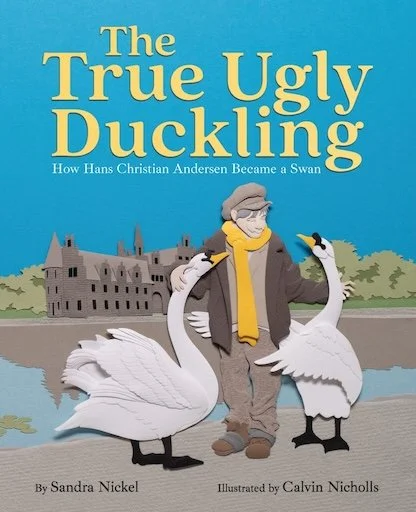
[Uma] I found your picture book so compelling because it has multiple layers of life and story, so that what seems like a straightforward chronological telling is anything but. Can you talk about how this project came about for you?
[Sandra] Thank you, Uma. The backstory is that my daughter had always struggled to find her place in this world during her growing up years. When she went to college, she at last discovered why. She was diagnosed as neurodivergent, as autistic. In my vast reading to learn more, I discovered two things about Hans Chrstian Andersen. First, that from his extensive writings and the writings of contemporaries, experts believe he was on the autism spectrum. Second, that he said his story The Ugly Duckling was really about him. It made so much sense to me in the context of neurodivergence. The Ugly Duckling is, in fact, the story of every neurodivergent child trying to find their place in this big world of ours.
[Uma] Were you struck by an Andersen story when you were young? Which one, and what was the magic it worked on you?

Photo courtesy of Sandra Nickel
[Sandra] Like so many children, Andersen’s tales were a big part of my growing up years. The Princess and the Pea, the Emperor’s New Clothes, the Little Mermaid. The tales that hit me hardest were the heartbreaking stories of The Little Matchgirl and The Ugly Duckling. The Little Matchgirl of course is the darker of the two tales because those around her never see her or offer compassion. Like my daughter, I also grew up not knowing I was neurodivergent, and so my experience felt similar to the Little Matchgirls’. I never felt that I was seen for who I really was, and I was torn apart at the idea that I would never be truly seen. That I would die that way. Her story, I think, encouraged me to mask more. To throw out the image that I was like others. So that I at least wouldn’t die alone. The Ugly Duckling, on the other hand, offered hope. That eventually I would be seen and appreciated for who I was.
[Uma] HCA compared himself to an ugly duckling, and you use that reference as an extended metaphor here. Was this text always structured like a fairy tale or did the structure emerge through revising and rewriting? Tell me more about that process and how it works for you, especially as it relates to the picture book form.
[Sandra] Somewhere, a long time ago, I heard a comparison about the different ways Beethoven and Mozart approached their work. I’ve never done the research to see if it’s true, but Beethoven was cast as someone who put his messy idea onto the page and then marked and marked it up until he got his creation to the place he wanted. Mozart, on the other hand, was cast as someone who did the revisions in his head and then put the completed project onto paper. My creative process is sometimes like Beethoven’s and sometimes like Mozart’s.
In the case of The True Ugly Duckling, my process was more like Mozart’s. I deeply wanted readers to see Andersen as a person who had struggled. I think most children don’t realize what adults have gone through to become the people they see before them—especially “great” people, who have left a large imprint on our world. In thinking about how I would reveal the truth of Andersen’s growing up years, my worries about the relatability of the historical context and the not-very-modern name, Hans, led to the decision to write in fairytale form. I wanted readers to feel empathy, not distance, so my story came out as a tale from the very beginning.
[Uma] I suspect many more people are aware of HCA’s stories than they are of his cut-paper art. What meaning do you draw from his use of scissors—was it diversion, focus, necessity? What meaning do you think young readers might draw from it?
[Sandra] For me, knowing how repetition and hyperfocus can be immensely helpful to an autistic person, I interpret Andersen’s paper cutting as a coping mechanism. He often did it at the same time he was publicly telling a tale. There’s this great quote from someone who had seen him storytelling while creating a paper cut out, and she said he seemed far more enthralled by his paper cut out than his story. She was incredulous. But Biographies about Andersen are filled with details about his anxiety about life and fitting in. I believe the paper cutting soothed Andersen as he stood in front of so many people, who might or might not be able to see him for who he truly was.
[Uma] Anything else you would like to tell me about the process of creating this book--maybe what surprised and delighted you about the artwork? And did anything change in the text once the artwork came in?
[Sandra] Calvin Nicholls, who is a paper sculptor, did the illustrations for The True Ugly Duckling, and his work is extraordinary. If all anyone has is a digital copy, they might not fully realize it. But once the book is in hand, it’s unbelievable. You can see that hundreds of individual paper cut outs make up one spread. It’s no surprise that it took Calvin two full years to complete the illustrations. He calls it an “epic challenge” in his career. I’m attaching Calvin’s spread where Andersen sails into Copenhagen. When I first saw it, I literally stopped breathing as I took it all in. The buildings reflected in the water. The movement of the ship. The wink to the swan. It’s truly magnificent.
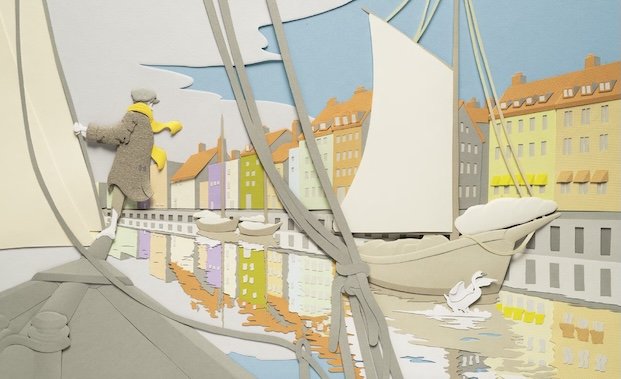
Art © Calvin Nicholls. Image courtesy of Sandra Nickel
And, no, nothing changed in the text after the artwork came in. There must have been magic sparkling in the air of Arthur Levine’s office the day he put Calvin and me together.
“…there were a few jewels…” That is what a director said, while rejecting one of the efforts young Hans made to write a play. This picture book is a love song to the boy who didn’t give up, an exhortation to all those young people who have those jewels inside and need courage to keep at the work it will take to bring them into the light.