The Opposite of More is Not Less: Together by Ece Temelkuran
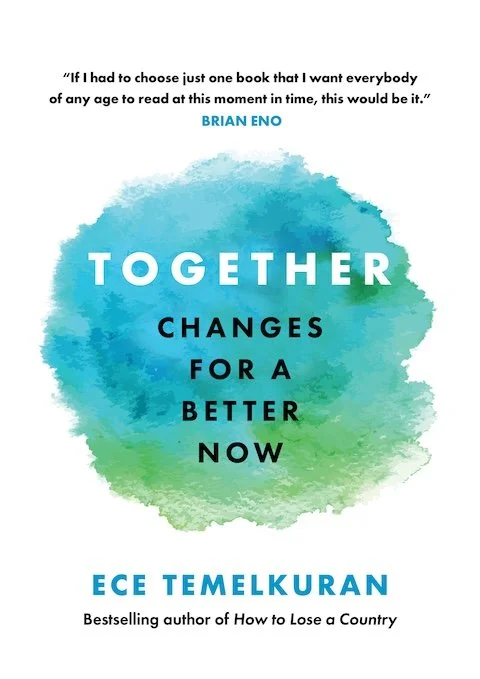
Together by political thinker and poet Ece Temelkuran traces upon the imagination the contours of a better world, a fairer world, a world where the toxic power play of a few need not create unrelenting misery for many. Her vision aligns remarkably with a vision of a fictional worldview that I’ve been chasing for decades without knowing it.
The book appears to have been published with a shifting, changing flow of subtitles: 10 Choices for a Better Now (Fourth Estate UK, 2021); A Manifesto Against the Heartless World (Fourth Estate UK, 2022); and Changes for a Better Now (Scribner Canada, 2025)
The e-book version I read uses the milder word, “changes,” in its subtitle, but there’s plenty of heartlessness described on the inside. The writer pulls no punches:
The gloves are off; the cutthroat world order no longer pretends to be pretty. The icing on the cake – the rule of law, liberal democracy, human rights and all that – is now unnecessary. All that we imagined would protect us from dark forces is melting. Fascism, after making strong footholds in the political sphere, is now threatening basic human morality.
The book creates an original vocabulary for a “politics of emotion.” It makes me think of my own aims in writing for young readers. Perhaps this is because I refuse to consider children's books as apolitical. All writing is political.
In the Book Uncle series, I've made choices about the occupants of that apartment building on St. Mary's Road, in the Chennai-lite Indian city setting of all three books. I may have followed intuitive pathways but they led me to a place that is all about community. A place where children from different linguistic and religious backgrounds can be friends. That does not seem like an outrageous thing to ask for, but in many real-life situations, it is exactly that. So I will keep insisting that people are capable of forging friendships like the ones in my fictional world.
Temelkuran writes:
“Now” is a devastating word.
Now is the image of a little girl who freezes in mid-step when it is her turn to jump over the skipping rope. As the others shout – “Now! Jump now!” – the rope starts to look like the tongue of a snake. Its every lick of the ground enunciates to the girl that it is always too late.
People like you and me are like that girl now, frozen in mid-step.
That’s my Anil, pushed by a bully, wanting to run away, wanting to push back, able to do neither. It’s also my Anil, frozen between the needs of the solar panel factory he wants to cheer along and the mangrove thicket it will threaten. It is the freeze that defines us, because all that we can control is how we react to it.
So what should we do in that situation, my characters and me? Temelkuran quotes an Iranian actress, Golshifteh Farahani, who was asked by a journalist if she had hope for her country as it fell into the grip of totalitarians.
For a split second she fell silent, as if the question annoyed her. Then she said, "I don't have hope for fire to burn. I don't have hope for water to flow. Human nature is to be free. Iran will be free.”
Personal experience interwoven with political observation, undergirded by family history, Together suggests that the answer lies in solidarity, in being with others, “breathing together.” I realize that is the story I have written, three times over, in these little books. These kids are on on a journey—together. They come up against the irrationality of the adult world—together. In their small universe, they resist walking away from fear. As Temelkuran writes, “Every fear offers us another piece of knowledge about ourselves – and about others – that we can record in our memories to refer to in future crises.”
Yes. That’s it exactly. We don’t have to look to heroes. Instead, we can build friendships and community. That is a far better vision of what it means to be human. It feels satisfying to know that this thread is present in the small swatch of story fabric that I have made. The solution to frozenness must arrive tangentially. It is always incremental. In the framework of Together, the opposite of “more” is not “less.” It’s “enough.”
Together enriches my vocabulary and makes me think about my writing, makes me want to write. I wish I could craft changes in real life to remedy injustice, fascism, fear. But fiction is my trade, especially fiction for young people, so that is where I'll draw connections. The subtitles might shift around, but I will trust that my readers will find fire and water in my stories, enough for them to keep a sense of shared humanity flowing out into the world.