A Walk into the Dark Wilderness: On Writing and Failure by Stephen Marche
I thought I’d made peace with the writing demons of insecurity by acknowledging them and expecting to encounter them in the process of writing every single book. Then a recent review knocked me off my wise-woman pedestal. The writer seemed to have read some other book than the one I’d written, and it was clear she didn’t care much for it. She’d also pinpointed every writing flaw I’d ever worked hard to overcome and raised it up under a glaring light for everyone to examine before they would inevitably decide that my little book wasn’t worth recommending to their children. Ouch!
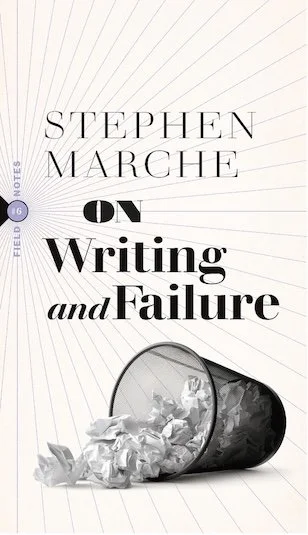
Enough of that. Engaging in conversations with reviews and reviewers just empties my reservoir of words and let’s face it, AI stealing my words is bad enough! I write this not to talk back to that review but because, in my search for something therapeutic to read, I came across On Writing and Failure by Stephen Marche. I thought I could take it with me on my walk into the dark wilderness of confronting failure.
Yes, failure, because a couple of dozen books and thirty-plus years of writing notwithstanding, a review like that can still get under my thin skin. For a few days, I couldn’t face my current work in progress without that review’s clever little barbs pinching and prodding me, reminding me of my rhetorical and storytelling inadequacies.
On Writing and Failure more than met my need for sanity and common sense. True, passages like this made me laugh while grinding my teeth:
The public only sees writers in their victories but their real lives are mostly in defeat. I suppose that’s why, in the rare moments of triumph, writers always look so out of place – posing on the Books page in their half-considered outfits with their last-minute hair…or, at the strange ceremonies of writing prizes, like the Oscars for lumpy people, grinning like recently released prisoners readjusting themselves to society.
Oddly, it helped me feel less cringey about my own pretensions by pointing out evidence of the self-doubt entertained by world-famous writers and the descent into obscurity of perfectly fine ones in the past.
No amount of success is a protection from the spectre of obscurity. There is no amulet against oblivion. Ever hear of Fitz-Greene Halleck? “No name in the American political world is more firmly established than that of Fitz-Greene Halleck,” Edgar Allan Poe wrote in 1843.
That steadied the ground beneath my feet, which just goes to show you what a bunch of neurotics we writers are. Some of the joy in this book came from Marche’s evident joy in the precision and elegance of words:
English has provided a precise term of art to describe the writerly condition: submission. Writers live in a state of submission. Submission means rejection. Rejection is the condition of the practice of submission, which is the practice of writing.
I've always maintained that publishing is the only industry in which the creators of the product form long lasting relationships with those who reject their work. My own deepest gratitude is reserved for those editors who rejected my early work—because, let's face it, I wouldn’t want to see those wannabe books out in the world today. But I'm also grateful not to be starting out today, in the instant era we live in, when “you can fail a dozen times before lunch.” In the old days, the postal service and self-addressed envelope allowed time to intervene between submission and rejection.
“You have to write. You have to submit. You have to persevere. You have to throw yourself against the door. That’s it. ”
Still, there’s comfort in being told that in order to be a writer you have to do the work for its own sake, that recognition is random and you have little control over it. That bears out in the lives of George Orwell, Ferdowsi, Agatha Christie, and Beatrice Beatrix Potter. (*Autocorrect bites again.)
If inspiration is what you're looking for, it’s in the drive to push through failure:
If you want inspiration, show me Johnson passed out on the glass-house floor, Melville scribbling Billy Budd on breaks from the customs house, Keats listening to the fountain by the Spanish Steps, Anna Akhmatova begging her friends to memorize her lines because she was too afraid to write them down.
No one can tell you that you have to be a certain way to be a writer, that you have to attend to the world or disregard it, love your family or reject them, remember or forget your suffering—none of that is the essence, Marche tells us.
You have to write. You have to submit. You have to persevere. You have to throw yourself against the door. That's it.
That’s more or less what I told my students, all the years I taught writing. How much do you want to do this? I told them that’s a particular kind of wanting. Wanting to be, not an author but a writer. So much in this book resonated with Teacher Me, who did her best, all those years, to speak from the soul of Writer Me. The sense that some writers wrote some books especially for me. The dawning knowledge that intention never aligns with result. The determination to keep on trekking through the dry gulch country of rejection. And even now, the way a negative review can fling me into a dark wilderness.
I should note that after reading this book, which Libby recommended to me, I started finding Stephen Marche’s name popping up repeatedly. He hosts a podcast, Gloves Off, about threats to Canada’s sovereignty and how the country can thrive in the new world disorder.
Then Libby popped up with the audiobook of a murder mystery curated by Marche and written by AI—no, really, don’t throw things at me! It was short, so I borrowed it. I found it mildly engaging while I was listening, and completely unmemorable the second the last sounds faded. To me, it confirmed the dead-averaging effect you get when you add AI to anything. Here’s a snippet from the NYT review of that book:
Fiction matters more now, in a world increasingly deracinated by technology. A.I. will never pose a threat to the real thing — to writing with convictions, honest doubts, riddling wit, a personal vision of the world, rawness and originality. Another word for these qualities is soul, which is exactly what ChatGPT lacks. Left wholly naked in front of the A.I. onslaught may be the writers of certain formulaic best sellers, but that’s a matter for their agents.
On Writing and Failure calls for soul as well. It tells me to get a grip and go where the work takes me. It speaks to a kind of certainty. When you’ve been writing for more than 30 years, you know you’d be less yourself if you stopped.