Process Talk: Dinesh Thiru on My Killer Family Reunion
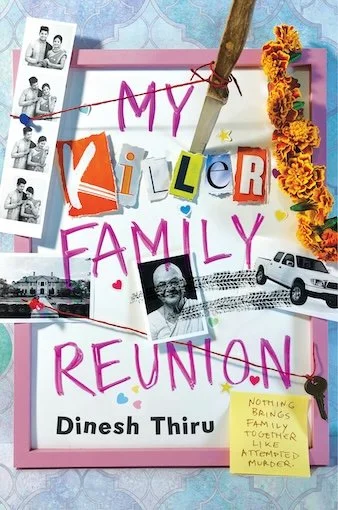
An attempted murder at a large, noisy, unwieldy Indian American family reunion in New Jersey forms the inciting incident in Dinesh Thiru’s YA comedy-mystery, or maybe it’s a mystery-comedy—My Killer Family Reunion. When a rich and cantankerous woman like Grand Mom gets knocked down by a car, what’s not to be suspicious about? Because wasn’t she really knocked down by her nephew in order to get her out of the way of said speeding car, and if that’s the case, why did he have to push her down so hard that she suffered a severe concussion?
The sleuth in this story is Jayshree Devi (known to all as Jay) who is also the brisk, opinionated first person narrator. She’s the young oddball in her family for wanting to join the military, which positions her nicely as the outsider with perspective—except, of course, the deeper Jay delves, the more she becomes entangled in family secrets. The publisher release calls this “Knives Out meets Never Have I Ever,” a twisty plot navigated by an earnest young protagonist who has to duck the machinations of a bunch of wacky relatives.
From publisher copy: Dinesh Thiru is a writer and stay-at-home dad currently living in Barcelona. He grew up in North Carolina, married his college sweetheart, and spent over a decade in San Francisco. Dinesh is half-Indian, half-white. He loves the ocean. He used to have other interests, but he swapped them for kids. Those kids are eight, five, and a dog. He is the author of Into the Sunken City and My Killer Family Reunion.
I’m delighted to welcome Dinesh Thiru to Writing With a Broken Tusk. Here are his answers to questions I sent his way via e-mail.
[Uma] I’ve seen a few Indian families at close quarters and even for an Indian family, this family is bonkers! They are larger than life, eccentric and funny—what part of reality and experience did you ratchet up to create these characters?
[Dinesh] My family is rather bonkers! This book is directly inspired by the Indian family reunions I attended as a kid (minus the murder), and I drew on many real events.
The entrance pooja for our love interest, Hernando—that actually happened to my girlfriend (now wife) when she first attended a reunion.
The desire to hook-up in a coat closet—in the book because my cousin & her boyfriend hooked up in a closet at a family reunion (note: the aunties totally busted them).
The inheritance drama—inspired by the legend of my great grandfather, a billionaire in India, he changed his will suddenly, died of a heart attack, and left all the money to charity.
The morbid humor—one of my mom's favorite stories is spreading her mother's ashes on a windy day, only for grandma to be blown back all over her clothes. Hilarious!
So yes, there was some ratcheting up of reality. But it didn't take much!
[Uma] I see a goldmine of material there for Jay’s story about finding her place in a big, loud, interconnected family spanning cultures and continents. Can you talk about the borders (cultural, linguistic, or other) that you’ve crossed in your life and what impact that might have had on crafting this story?
[Dinesh] I'm half-Indian, half-white, like Jay, and many of my experiences informed Jay's sense of belonging—feeling "Indian, but not quite Indian enough."
When I was young, if my immediate family went out to a restaurant, often the host would ask, "Are you all together?"—as if we couldn't possibly be together.
When I go to India, I feel like I should fit in. I have brown skin, an Indian name, family there—yet my American self sticks out like a sore thumb.
As for borders, I lived my whole life in the US, but we moved to Spain three years ago. Last summer, we went to India, and one night I was explaining to my kids that we came so they would understand their identities more. "You're Indian and American," I told them, and my nine-year-old said, "And also Spanish!" Suffice to say, I've managed to confuse my kids even more.
[Uma] Confusion isn’t a bad state of mind for this world, right? Let’s talk language. How did you go about weaving in Tamil dialogue from the aunties and uncles while keeping it natural and making the meaning contextually clear? Any dialogue tips?
“My sincere apologies to my cousins, aunties, and uncles who inspired a cast of murder suspects. For the readers, please wish me luck on launch day, when my family members read the book… and subsequently ban me from all future reunions.”
[Dinesh] This wasn't easy! My Tamil is awful, and I relied heavily on friends and family. That said, there are certain words (like a good old-fashioned "Aiyo") that are deeply ingrained from hearing them so much growing up. It also helps that, in my family, it's quite common to mix Tamil and English into the same phrase—this enables the reader to get the meaning from the context.
[Uma] Tamlish, yes of course! Now to characters. You have a rich array of them—the lesbian cousin and her girlfriend, the creepy uncle, Grand Mom herself, Jay’s religious counselor dad, and so many more. Do you have a favorite character in the line-up? Who is that and why?
[Dinesh] It's cheating, but I have to say Grand Mom. She's most directly inspired by my paati, my Indian grandmother, who was a matriarchal force, the last of twelve siblings, and lived until 103. She was born into one of the richest families in Bangalore, but she also lived extremely poor, surviving for years on one cup of food per day. She read poetry to Gandhi when she was young. She had a wicked cackle. She could silence a room with one withering glance.
I'm thrilled for Grand Mom to contribute a small part to her legacy.
[Uma] She sounds amazing. Reading to Gandhi? Tell me more. I can’t let that slide by!
[Dinesh] As I mentioned, my great grandfather was an extremely successful businessman in Bangalore. His wife was involved in the independence movement. Apparently, Gandhi came and stayed at their house on Lal Bagh Road in Bangalore. This is in the early 1930s. Before he came, my great grandmother threw away all the leather furniture in the house (something that made her husband quite upset), and she had 70 goats installed in the backyard because Gandhi was only drinking goat’s milk. In the evening, my grandmother (probably 8 or 9 at the time) would read poetry to entertain Gandhi and his entourage.
Wild, right? To be a fly on the wall in that home!
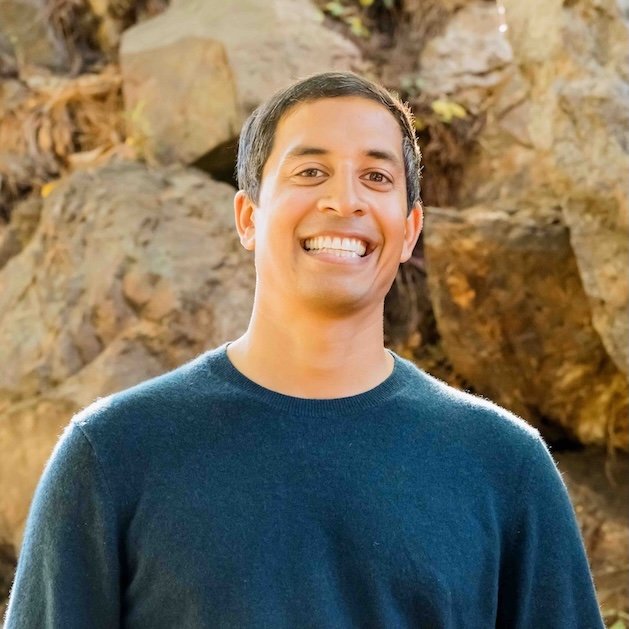
Photo © Nicholas Stennet
[Uma] Wildness! Okay so anything you want to say to your real-life, present-day extended family?
[Dinesh] My sincere apologies to my cousins, aunties, and uncles who inspired a cast of murder suspects. For the readers, please wish me luck on launch day, when my family members read the book… and subsequently ban me from all future reunions.
Thanks, Dinesh! And thank you for this funny, warm-hearted romp of a story.