Process Talk: Caroline Starr Rose on Books Up the Mountain
A writing group is more than the sum of everyone in it. You share manuscripts at various stages of progress. Some fall by the wayside, others make it to completion. You celebrate successes and commiserate over the inevitable disappointments. You get to know one another and develop shorthands of communication that no one else understands. And every once in a while, you get to witness a story idea that the writer knows has arrived as a gift in her life and you are lucky that you are going to run alongside as she develops it.
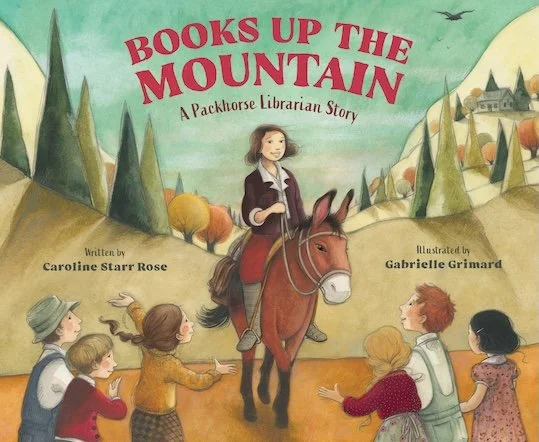
Here’s one of those projects: Books Up the Mountain, a picture book by my friend and colleague Caroline Starr Rose, illustrated by Gabrielle Grimard. And here’s Caroline, e-chatting with me about the book.
[Uma] What drew you to this story in the first place and how does the final book align with your early intentions for it?
[Caroline] In 2019, I read The Book Woman of Troublesome Creek and knew I had to write a picture book based on Eastern Kentucky’s Packhorse Librarians. I also figured that every picture book author who read this marvelous novel (really, go check it out) was already planning their own Book Woman book. (The packhorse librarians were affectionately called Book Women by their patrons.) I mean, who writes for children and doesn’t hold the library in the highest regard? Who wouldn’t want to write about library services reaching rural Appalachia for the very first time? Who could resist telling the story of women who served their communities by carrying pillowcases, baskets, or saddlebags filled with books up steep mountain trails and through roaring creeks with ominous names like Cut Shin, Troublesome, and Hell-for-Sartin?
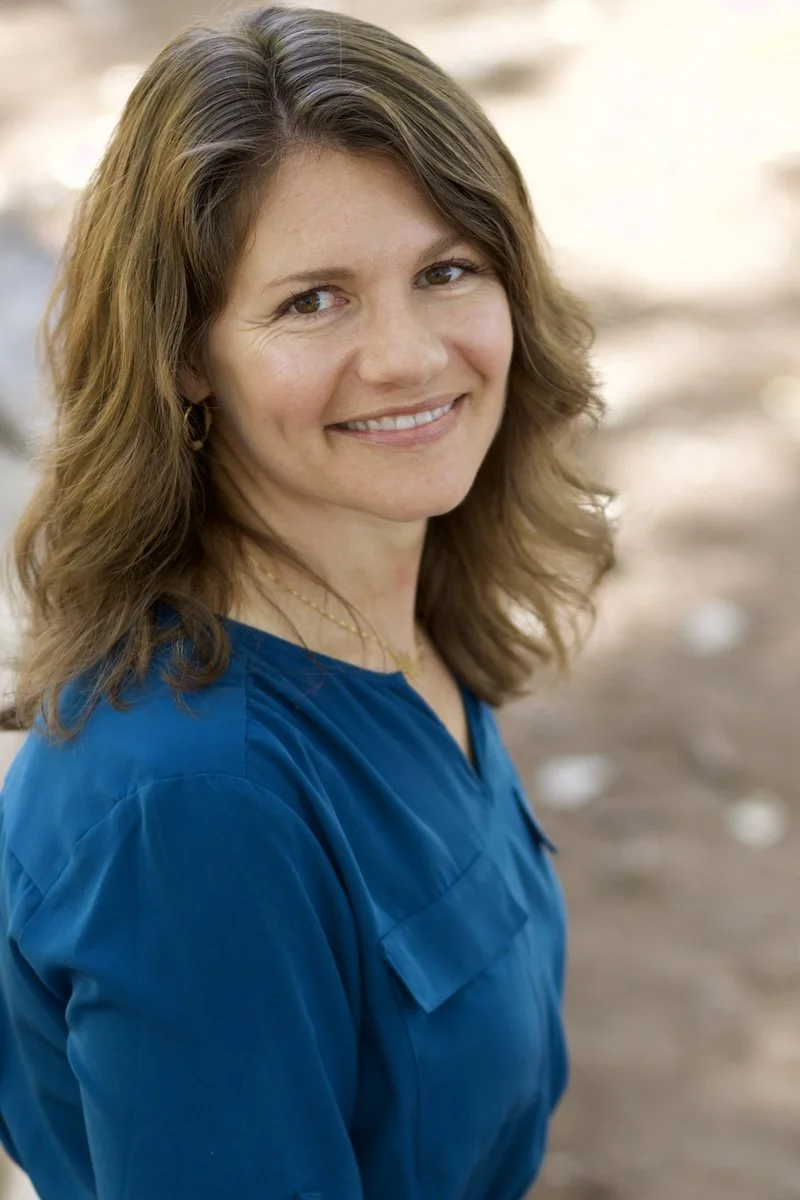
Photo courtesy of Caroline Starr Rose
Not long after I read Jojo Moyes’s The Giver of Stars, another Book Woman novel that coincidentally came out months after The Book Woman of Troublesome Creek. By then I’d already started my own manuscript.
It is never easy for me to envision how a book will turn out, but I will say the final version of Books Up the Mountain does all the things I hoped it would. It shows the devotion of these women to their communities, the hard work they put in day after day, and the transformative power of reading.
[Uma] Can you talk about how you’ve used rhyme in this text? It’s not there in every stanza but it certainly plays a role.
[Caroline] I like to say I write by ear. I can’t really tell you I plan the rhyme, but I definitely feel where it wants to go. Sometimes I don’t even realize that’s what I’m doing when I sense what the next word is supposed to be. It’s almost like I’m resolving something that had previously been unfinished or left undone (which is often how I experience music and reading, as a collection of unresolved and resolved moments).
[Uma] The text on the opening page feels at once close to a single action and vast in scope. It speaks not only to book women's purpose but to that moment in the early morning, that feels somehow liminal and mysterious. What do you think led you to settle on this opening, this scene?
“Sometimes I hear in what I write an echo of what I’ve read elsewhere. Sometimes it’s my own, earlier writing, sometimes it’s something I can recall, sometimes it is something I can’t put my finger on.”
[Caroline] I’m not sure exactly, but I do know apart from the addition of a single “the”, this stanza has stayed the same from the very first draft. Here’s how it reads:
Before the birds begin to sing
or (the) sun makes plans to rise,
Book Woman checks her saddlebags.
I wanted to show how early this work began, and focusing on that time before sunrise, before birds are even stirring in their nests, well, this felt like a strong way to communicate the hard work and the long day ahead.
[Uma] So the cadence of this reminds me of an old Anglican hymn that is planted in my memory from having attended schools run by missionaries in India—you know, back in the last century. Before the hills in order stood/ or Earth received her frame…
[Caroline] That is so cool, Uma! Sometimes I hear in what I write an echo of what I've read elsewhere. Sometimes it's my own, earlier writing, sometimes it’s something I can recall, sometimes it is something I can't put my finger on.
Also, I love that idea. The hills standing in order. It reminds me of the book of Job talking about the roots of the mountains. There is a lot of gorgeous nature imagery in the Bible / Christianity.
[Uma] That makes sense. Religious texts are so often also works of literature. Can we talk pictures? The art in this book is nothing short of incandescent. Leaves hover in the air so you can practically see them moving in a breeze. The little mule’s eye is so gentle you can imagine it blinking. Can you talk about the process of writing text for picture books, and particularly this one, before the art comes in, before you know what it will do to carry your story forward? How do we write so our words become capable of inviting art?
[Caroline] Isn’t it just beautiful? I am so in love with what this book has become. My publisher asked what I was hoping for in an illustrator, and I said I wanted someone who could evoke nostalgia. Of course, nostalgia is different for everyone, but what I meant by that was for the art to hold a warmth and a welcoming. And my goodness, that’s exactly what these illustrations stir in me. Gabrielle Grimard did a remarkable job.
What a wonderful idea, Uma, of writing words that are capable of inviting art. How do we do that? For me, it comes down to heart. I have to love the subject I’m writing about. It needs to excite me and be something I can’t help but share. It’s my job to express my admiration and show a story’s beauty via the words, the form, the bits and pieces I choose to include in the text. Then the illustrator catches her own vision and makes the book far bigger and better than my small offering. When the words and illustrations are added together they equal far more than they ever could alone. That’s the magic of the picture book.
Warm and welcoming and a visual delight from start to finish. Congratulations, Caroline!