Ourselves in Orwell: Why I Write
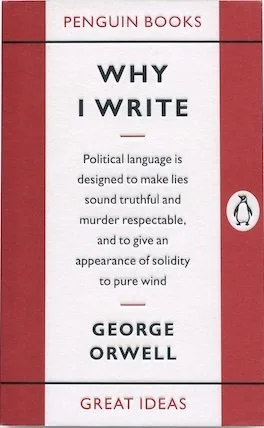
1984 and Animal Farm may be the most obvious Orwell picks these days. Me, I’m reading Why I Write, a little Penguin compilation of four essays:
The titular “Why I Write” begins:
“From a very early age, perhaps the age of five or six, I knew that when I grew up I should be a writer. Between the ages of about seventeen and twenty-four I tried to abandon this idea, but I did so with the consciousness that I was outraging my true nature and that sooner or later I should have to settle down and write books.”
“The opinion that art should have nothing to do with politics is itself a political attitude.”
Which, when I stop to think about it, is marginally reassuring. That would have been me, exactly, driven to write. Except this writing business was not within my purview on account of my being brown and growing up in India, which seemed to put such aspirations firmly beyond my reach. He writes about the joy of discovering words, including the mystery of archaic spelling and I get all of that. Then we get to the four great motives for writing:
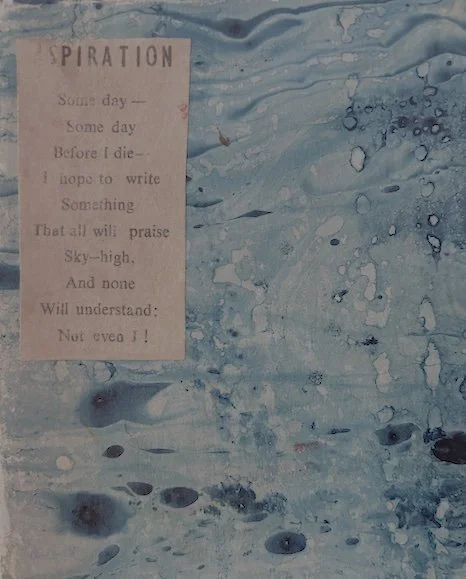
Didn't write this back in 1969, but found it and claimed it. Marbled that paper myself, so the stuff of writing—paper, words, ink—had me in its grip already.
Sheer egoism. Check. Look at this little clipping I glued at the age of 14 to the marbled paper cover folded over the jacket of a short story collection. Aspiration on wheels.
Aesthetic enthusiasm. Loved words, was bemused and intrigued by their arrangement. Still true.
Historical impulse. Orwell talks about this as a desire to find out facts. This one endures. I could lose myself in research quite happily.
Political purpose—Orwell uses the word broadly, signifying a desire to push the world in a certain direction. This one rings truer with every passing year.
…no book is genuinely free from political bias. The opinion that art should have nothing to do with politics is itself a political attitude.
“The Lion and the Unicorn,” with its reflections on World War II-era Britain, is almost three essays in one, with the first part examining the growth of Fascism in Europe, laying down a pathway to the writing of 1984. Opening line:
As I write, highly civilized human beings are flying overhead, trying to kill me.
There’s a gentle acknowledgment of the old-fashioned outlook of the English, and of the fact that the rich and the poor may in fact be two nations. Jabs at insularity and hypocrisy about Empire find reflection in the contrast between the dullness of the British army and the goose-stepping smartness of European Fascists. Strip all irony from this and you have 47 hankering for North Korean-style military parades. The concentration of property and wealth in a few hands is a sustained critique.
Orwell is complicated, as the layers of his legacy reveal, peeled back in this article about travel to his birthplace in India. Along with “Shooting an Elephant,” (not in this collection) “A Hanging” is probably the Orwell essay I remember most vividly. Watching the condemned man go to his execution, he sees him involuntarily avoid stepping in a puddle.
It is curious, but till that moment I had never realized what it means to destroy a healthy, conscious man. When I saw the prisoner step aside to avoid the puddle, I saw the mystery, the unspeakable wrongness, of cutting a life short when it is in full tide.
The final essay in this little volume is “Politics and the English Language,” and I love this one for its small obsessions:
Our civilization is decadent and our language – so the argument runs – must inevitably share in the general collapse.
Ha! What might Orwell think of how language has changed in the 21st century? Of the Internet? Of social media? Of AI? Idle speculation aside, his cautions against verbal false limbs and inflated diction hold up surprisingly well, and barring his antagonism to the use of “foreign” phrases (isn’t English itself half-foreign?) his tidy little bulleted set of rules still makes sense.
i. Never use a metaphor, simile or other figure of speech which you are used to seeing in print.
ii. Never use a long word where a short one will do.
iii. If it is possible to cut a word out, always cut it out.
iv. Never use the passive where you can use the active.
v. Never use a foreign phrase, a scientific word or a jargon word if you can think of an everyday English equivalent.
vi. Break any of these rules sooner than say anything outright barbarous.
If you want even more Orwell dots connected, these posts might work for you. Or check out this Democracy Now interview with the makers of last year’s documentary film, Orwell: 2 + 2 = 5. Because whatever details of his time he read or misread or was constrained by, Orwell’s real genius lies in the fact that we can’t stop seeing ourselves in his words.