Writing With a Broken Tusk

Writing With a Broken Tusk began in 2006 as a blog about overlapping geographies, personal and real-world, and writing books for children. Since March 2024, Jen Breach (writer, VCFA graduate, and former student) has helped me curate and manage guest posts and Process Talk pieces on this blog.
The blog name refers to the mythical pact between the poet Vyaasa and the Hindu elephant headed god Ganesha who was his scribe during the composition of the epic narrative, the Mahabharata. It also refers to my second published book, edited by the generous and brilliant Diantha Thorpe of Linnet Books/The Shoe String Press, published in 1996, acquired and republished by August House, now part of Reading Is Fundamental, and still miraculously in print.
Posts on this site reflect personal opinion and commentary protected under the Canadian Charter of Rights and Freedoms and the First Amendment of the US Constitution.
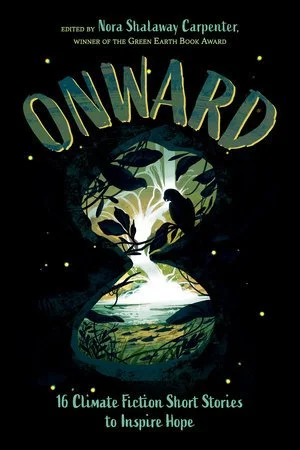
Guest Post: Nora Shalaway Carpenter on Curating and Editing the Climate Fiction Anthology, Onward
Nora Shalaway Carpenter (my former student, I’m proud to say) has edited a fine array of climate-centered short stories in a new anthology, Onward: 16 Climate Fiction Short Stories to Inspire Hope. In the foreword Nora writes about the vulnerability of the next reading generation, dubbed “Gen Dread” for the understandable anxiety they express at growing up in a world increasingly beset by climate devastation and disasters. Yet we are still human, together on the only planet that is currently our home. That's the overwhelming message in these stories.
Each piece advances the theme in a different way. Seeds carry the impossible eluctation of hope in a devastated world (“The Care and Feeding of Mother” by Erin Entrada Kelly). You can travel to the farthest place from humanity on the planet, and be surprised (“Graveyard for the Sky” by Aleese Lin). A shocking turn in an election for class president (“The Manatee is Not a Meme” by Gloria Muñoz) leads to an impulsive gesture of commitment. For a kid hauling trash on a lakeshore beach (“Blue Glass by Anuradha D. Rajurkar) guilt is isolating and personal but redemption shows up in connection. Settling into resentful teenage (“A Trashy Love Story” by Sarah Aronson), a girl is jolted into seeing who she was, and who she might become. Most of the stories are in prose, with two in verse. Together, they reach into uncertainty, perhaps into time itself, like the protagonist of Rachel Hylton’s sensitive, elegant contribution, “The Stealth Arborist.”
Nora sees bringing an anthology into being as a process akin to building community. Here’s her reflection on the creation of this book.

What Makes Us Who We Are? The Ugly Little Boy by Isaac Asimov
Isaac Asimov’s short story, “The Ugly Little Boy,” was one of his own favorites, a tale of a nurse and the little Neanderthal child she’s been hired to care for. In Asimov’s words:
…I have received letters from people who say that they cried when they read the last part of the story, and I always answer and say well I'm glad they did because I cried when I wrote it and in fact I cried when I just read it, so I guess it means something to me.
I read “The Ugly Little Boy” not in its first appearance in Galaxy magazine under title “Lastborn” but in the Nine Tomorrows collection. The Neanderthal child has been brought via time travel to a specially constructed lab to be studied.
Setting: Interior Landscapes
There are interior landscapes among us badly in need of just the kind of rewilding that ecologists are calling for in the real world. It’s worth remembering that the Indian subcontinent, like the planet itself, is shared space.
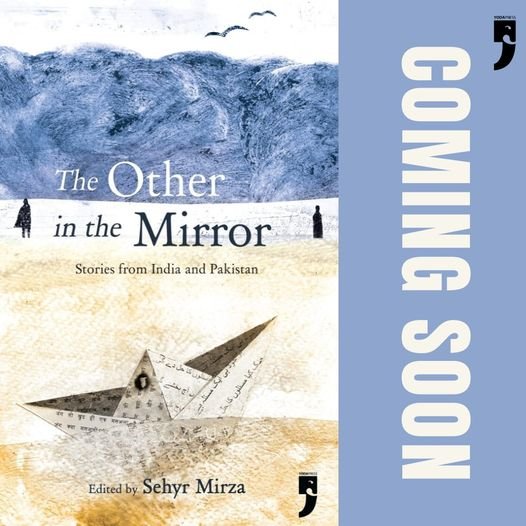
A couple of years ago, right around the first uneasy rumbles of the Covid pandemic, I received a request for a short story from Sehyr Mirza, a Pakistani creative writer and journalist who was planning to edit an anthology of short stories for young readers. Here is the ethereal jacket image now created by Priya Kuriyan for that anthology, The Other in the Mirror: Stories From India and Pakistan, coming soon from Yoda Press in India and Folio Books in Pakistan!

Small Perfectly Balanced Story Containers
For the last few months, because of the Picture Book Intensive, I’ve posted mainly about that small, perfectly balanced story container, its blend of images and words served up for the youngest of readers. The short story is another small container whose compactness calls for distilling the essence of a story.
The Right Ghost
A couple of weeks ago, I was tinkering with the ending chapters of a middle grade novel that has resided in my files for some time. I’ve read pages from it occasionally at VCFA residencies. But now I’m down to the last stretch of writing it, and I’m noticing something.
I tend to be picky about what I read at this stage of a draft. Something very different seems best, as if I ought to put a wall up between the reading and writing spaces in my mind.

Through an Anthropologist’s Fictional Lens
I don’t usually reprint content from other sites and I rarely go far from the thing I care most about, literature for children. But I found this short story in Sapiens oddly moving and poetic. I liked its use of language, the way it circles back on itself, creating oppositions (nobody knows and everybody knows) and the impact it delivers in the very last lines.

Imagine 2200: Cli-fi Short Story Contest
Environmental nonprofit news outlet Grist’s solutions lab, Fix, has launched a new climate-fiction short story contest. Imagine 2200 calls for stories (3,000–5,000 words) that envision the next 180 years of equitable climate progress.