Guest Post: Nora Shalaway Carpenter on Curating and Editing the Climate Fiction Anthology, Onward
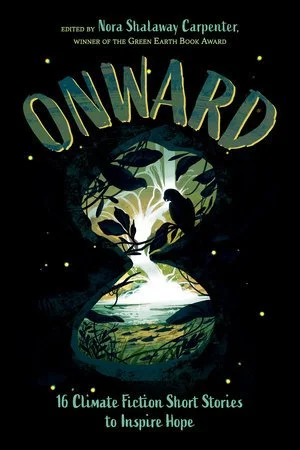
Nora Shalaway Carpenter (my former student, I’m proud to say) has edited a fine array of climate-centered short stories in a new anthology, Onward: 16 Climate Fiction Short Stories to Inspire Hope. In the foreword Nora writes about the vulnerability of the next reading generation, dubbed “Gen Dread” for the understandable anxiety they express at growing up in a world increasingly beset by climate devastation and disasters. Yet we are still human, together on the only planet that is currently our home. That's the overwhelming message in these stories.
Each piece advances the theme in a different way. Seeds carry the impossible eluctation of hope in a devastated world (“The Care and Feeding of Mother” by Erin Entrada Kelly). You can travel to the farthest place from humanity on the planet, and be surprised (“Graveyard for the Sky” by Aleese Lin). A shocking turn in an election for class president (“The Manatee is Not a Meme” by Gloria Muñoz) leads to an impulsive gesture of commitment. For a kid hauling trash on a lakeshore beach (“Blue Glass by Anuradha D. Rajurkar) guilt is isolating and personal but redemption shows up in connection. Settling into resentful teenage (“A Trashy Love Story” by Sarah Aronson), a girl is jolted into seeing who she was, and who she might become. Most of the stories are in prose, with two in verse. Together, they reach into uncertainty, perhaps into time itself, like the protagonist of Rachel Hylton’s sensitive, elegant contribution, “The Stealth Arborist.”
Nora sees bringing an anthology into being as a process akin to building community. Here’s her reflection on the creation of this book.
Story as Community and Activism
by Nora Shalaway Carpenter
“Community itself is resistance. It lives at the intersection of resistance, tragedy response, and caregiving. ”
When I first began my writing journey, I never imagined I’d help bring four anthologies (three fiction and one non-fiction) into the world. Despite educators’ love of them, anthologies are notoriously difficult projects to birth. They require lots of labor, love, and logistical prowess. Indeed, their notoriety has led many people to ask: “why do you keep doing this?”
For me, the answer comes down to creating something larger and more impactful than what my own voice can produce alone. It comes down to community. Each story in Onward, for example, is authored by one person, but taken together the pieces become a kind of communal storytelling. And communal storytelling has always been at the heart of human communication and survival. As we’ve seen during the Minneapolis ICE raids and indeed throughout history, Community itself is resistance. It lives at the intersection of resistance, tragedy response, and caregiving.
I write for all kinds of reasons, but my fiction tends to revolve around issues of social justice. Writing is, in a very real way, my activism. The very first anthology I edited, Rural Voices: 15 Authors Challenge Assumptions About Small-Town America arose because I was sick and tired of the way much of American society villainized and stereotyped rural people. The goal of that collection was uprooting stereotypes. But with Onward, it wasn’t enough to only show how climate change impacts different people and populations. That was a goal of the book, sure, but so was providing stories that offered hope to readers weighed down by climate grief and even apathy. Just as important is the detailed, virtual resource section that accompanies Onward. The hard truth is that we are long past the days when bringing attention to environmental matters was enough. Now, we need to simultaneously encourage young readers to understand the goal of climate work, reassure them they’re not alone and the situation isn’t completely hopeless, and empower them to engage with climate and environmental activism in a consistent and meaningful way.
These might seem like lofty goals for one book, and to be clear, I am in no way suggesting that Onward can do all this work on its own. There are tons of incredible resources out there. So many, in fact, that people can easily become overwhelmed and not know where to start. That’s where Onward comes in. The point of the collection is to let our Generation Dread members know there is reason to keep working, and to also introduce them to tools to let them immediately start that work. Readers inspired by Sarah Aronson’s protagonist in “A Trashy Love Story,” for example, might get involved in Dayenu. Teenage readers with climate project ideas might learn of and apply for a NatGen Seed Grant or become involved with Re-Earth Initiative. And anyone navigating climate grief will find tips and resources under the section “Continually Acknowledge and Manage Eco-Anxiety.”
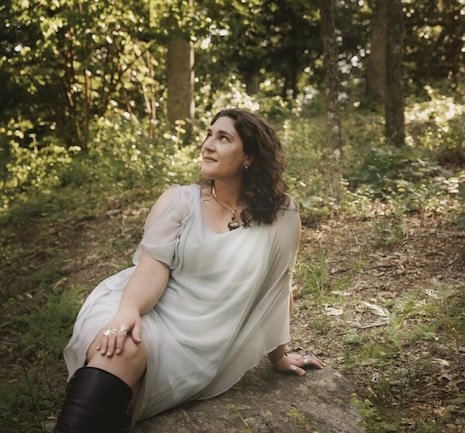
Photo by Hayley Brooks, used by permission of Nora Shalaway Carpenter
When I approached authors about potentially contributing to Onward, I intentionally gave them free rein to write about any aspect of the climate crisis. As a result, the stories run the gamut from thriller and speculative fiction to historical and contemporary, exploring everything from water hostage situations to beach clean ups to all-plant extinction. None of the protagonists try to save or solve everything. Importantly, they home in on the main issue threatening their communities. If every reader did the same, our local communities and Earth would be a lot better for it.
Each story in Onward does seem to bring its own voice to a complicated conversation, yet together, they invite readers to join in that conversation, find comfort where it appears, and, importantly, take something of this collection out into their own quotidian world. Thank you, Nora, for this engaging, important work.