Guest Post: Loree Griffin Burns on Extreme Birdwatching
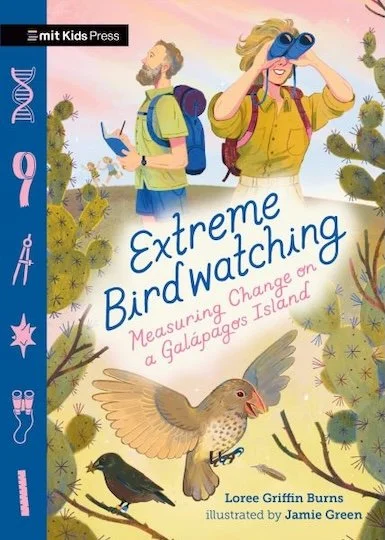
In Extreme Birdwatching: Measuring Change on a Galapagos Island, Loree Griffin Burns zooms in on a single island from the famed archipelago. Welcome to Daphne, not the kind of island you might go to for a beach vacation—no sandy beaches or resorts or even shade, and its volcanic crater is home to thousands of nesting blue-footed boobies:
For all these reasons, most people who visit this part of the world sail right past Daphne. But there are an unusually determined and curious few who’ve stopped, who’ve gone ashore, and who’ve seen astonishing things there.
This is the story of those people.
Even more, it’s the story of those astonishing things.
Loree’s book is packed with information as it traces Peter and Rosemary Grant’s forty-year study of the finches on Daphne Island. For four decades, they studied hundreds of birds twice each year, precisely measuring their beaks, wings, and bodies, banding them, and recording the entire process. Illustrated by Jamie Green, this book is also filled with a clear affection for those “astonishing things” that abound on the island and for the people, no less admirable, who study them.
Loree writes here about using the power of story to persuade, writing through the human complications of opposing beliefs and toward understanding.
What’s in a Word?
by Loree Griffin Burns
Scientific vocabulary irks me sometimes. Say, for example, I’m writing about the life of a honeybee and I have to stop and explain words like anther or pollination or proboscis or honey crop. These are all perfectly excellent words, precise and apt. But if the narrative I’m weaving needs only to convey that a bee has left her hive, flown to a nearby apple tree, landed on a blossom, sipped nectar, and then carried that nectar back to her hive for sharing, well, the technical words might do more harm than good. Particularly with an audience that is new to honeybees.
“I wanted to find a way into the story of this landmark discovery that didn’t start with words like evolution and natural selection.”
Never has the burden of scientific words weighed so heavily on my mind as when I set out to draft Extreme Birdwatching: Measuring Change on a Galapagos Island. I spent a lot of time thinking about how to layer scientific context through a carefully choreographed introduction of information and ideas, hoping to build knowledge slowly, chapter by chapter, sidebar by sidebar, instead of definition by definition.
The focus of Extreme Birdwatching is Peter and Rosemary Grant’s forty-year study of the finches of living on one uninhabited island in the Galapagos. The Grants’ decades of close and detailed finch observation showed—beyond doubt and to the surprise of biologists everywhere—that evolution by natural selection does indeed happen ...and that it does not require the eons of time that scientists since Darwin have supposed. I wanted to find a way into the story of this landmark discovery that didn’t start with words like evolution and natural selection.
Photo courtesy of Loree Griffin Burns
While working, I reread one of my all-time favorite science narratives—the one that had introduced me to the Grants and their work back in the 1994: Jonathan Weiner’s The Beak of the Finch. In its final pages, Weiner shares a story about biologist John Endler, who studied guppies and how their scale colors change over time in response to the presence or absence of guppy-eating predators in their environment. (Short version: if you are living in a pond where other animals want to eat you, your chances of survival are better if your scales are drab and hard-to-see. If you are living in a predator-free pond? Well, then it’s safe to be colorful.)
While on an airplane once, Endler chatted with his seatmate, a stranger, about his work with guppies. He explained the rationale behind his experiments and described what happened to guppy color patterns across generations when he forced them to live their lives in predator-filled versus predator-free ponds. He shared what he thought it all meant. His seatmate was astounded.
“What a neat idea!” the seatmate said. “What a neat idea!”
But when Endler told his seatmate that this neat idea is evolution, everything changed. The man’s excitement turned to anger.
Here the word evolution isn’t problematic because its meaning is obscure but, rather, because its meaning has become socially charged.* In The Beak of the Finch, Endler muses that it might be interesting to write a book about the experiments that prove the reality of evolution by natural selection without using the word evolution until the very last page.
It was a lightbulb moment for me. I doubled down on my low-jargon approach and crafted a basic and easy-to-follow narrative that led to the word evolution rather than starting from it: how does one get to an island like Daphne? How do you capture and identify every bird that lives there? How do you track their physical features? How do you learn about their daily lives, what they eat, and how often? Where do you put all this information once you’ve collected it? And what, pray tell, might you learn from it?
A whole lot, as it turns out.
Loree’s post pays homage to looking close at the work you love, examining its complications from many angles, asking lots of questions. In a world of strident opinions not always grounded in very much fact, it’s a road-map toward focus and away from looming distractions. The natural world can’t wait for us humans to get over our petty squabbles. Conversations about evolution always feel like a nudge to me to think instead on longer scales of time. Like so much else in the natural world, this story reminds us we’re only here briefly on this glorious planet, with so much around us to marvel at.