Guest Post: Jesse Weiner on Embracing Uncertainty
Jesse Weiner holds an MFA in Writing for Children and Young Adults from the Vermont College of Fine Arts, where I taught for sixteen years and became, I’m convinced, a better writer for it. Among the awe-inspiring faculty members the year I joined was Norma Fox Mazer—quiet, clear-eyed, she wrote words that sang themselves off the page. Why do I raise this? When Jesse was a student at VCFA, she won the Norma Fox Mazer Award, which recognizes excellence in craft. Those are the kinds of overlapping circles that feel like gifts.
Jesse’s a cross-genre writer and poet. Her work has appeared in places like The Saturday Evening Post, Cosmic Horror Monthly, and Poetry Hall. Jesse is also a writing coach and developmental editor through her business, Inksational Editorial. She also runs a free newsletter with open submission calls, contests and grants, and other industry info. Click here to learn more and sign up.
I’m delighted to welcome Jesse Weiner to WWBT.

Photo © SonjaK Photography. Image courtesy of Jesse Weiner
Taking Comfort in Discomfort: How to Embrace Uncertainty in Your Creative Practice
by Jesse Weiner
I used to believe myself incapable of writing poetry. I didn’t think the themes I was interested in exploring were worthy of being made into poems, let alone ones someone would want to read.
In hindsight, I was operating from the belief that my lived experiences weren’t worth writing about or sharing, which was blatantly false. But as a woman who came of age in the culturally-ingrained misogyny of the 90s and early 2000s—and in the Bible Belt, to boot— I’m still working to recognize and reprogram some core misbeliefs. I’ve also had help with that reprogramming in the form of writing partners and mentors who lovingly, gently encouraged me to try new things—poetry included.
Writing in this particular form still feels fresh and new and at times scary, but some of my poems have actually been published and translated into Chinese. And I even got an offer of publication for a novel in verse—opportunities I never could have imagined for myself while stuck in an “I can’t” thought cycle.
Given this background, you’ll likely be unsurprised to learn that I hate hearing other writers say “can’t.” We are smart, capable, inventive people who literally spend our time making something out of nothing. “Can’t” isn’t a truth; it’s a feeling.
To be fair, when someone tells me that they “can’t” write short stories, or poetry, or a screenplay, what they might actually be saying is that they’re not interested in writing in a specific genre or for a specific audience. But it’s also possible that their “I can’t” stems from fear; that they’re hesitant to try something new for fear they won’t be good at it. It could also be fatigue. Writing is hard, at every step. When you’ve been working your tuchus off to excel at your craft, the thought of hitting pause to try something new might feel taxing, overwhelming, daunting.
“ To be clear, I’m not saying we should all jump into a frozen lake. But there is great value in learning to embrace discomfort.”
It's one thing to try something and decide it isn’t for you. It’s another thing entirely to let fear, doubt, and uncertainty to guide your creative choices. To bar yourself from an experience which has the very real potential of being fun, inspiring, insightful, and freeing.
So how do we break the “I can’t” cycle? How do we move past negative and limiting beliefs to find the courage to try writing in new genres and forms?
My first suggestion is to give yourself the gift of time. A huge part of learning to say yes to trying something new is permitting yourself the time to do so. Whether you’re struggling with procrastination, or writer’s block, or you’re a people-pleaser who puts everyone else first, you can find 5-15 minutes to engage in imperfect, playful writing. Keeping this initial writing goal small makes it easy to achieve. It also makes it harder for you to talk yourself out of it.
My second suggestion is to Wim Hof it. Wim Hof, aka The Iceman, is a Dutch motivational speaker and an extreme athlete who promotes deep breathing exercises and regular cold plunges. To be clear, I’m not saying we should all jump into a frozen lake. But there is great value in learning to embrace discomfort.
Try saying yes to something that forces you outside of your comfort zone, if even a little. To be clear, this doesn’t have to be some big, bucket-list item, but it should be something that breaks your normal routine. Maybe you try writing in that new coffee shop around the corner. Maybe you take a pottery class, or try a new recipe, or try a new sport. Whatever your pick, I’m convinced that choosing to get uncomfortable—and weathering all of the little fears and insecurities that might arise with trying that new thing—can help us to (re)build mental fortitude as creators.
Once you choose to gift yourself with new experiences, it becomes easier to translate that same spirit of excitement and possibility into your creative life.
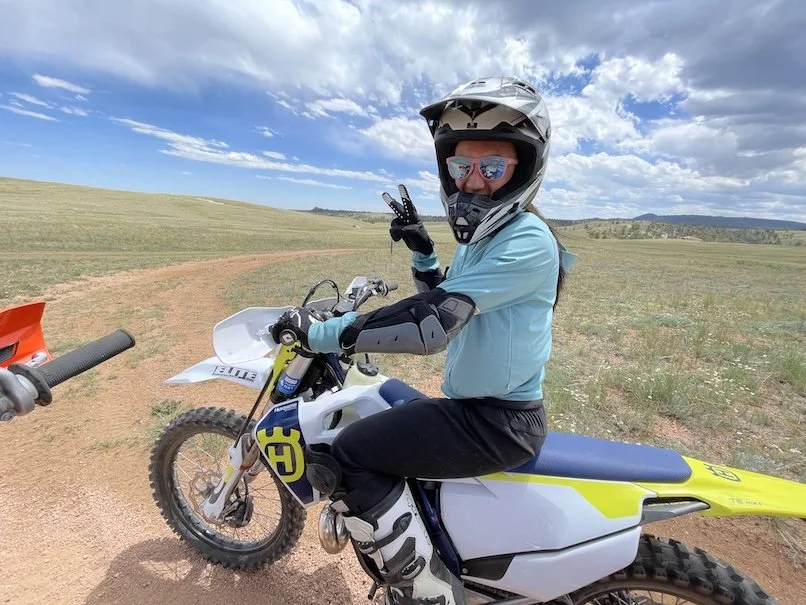
Jesse writes: I’m slowly learning to dirt bike—despite a very real fear of crashing. But that’s the thing about dirt biking: you will fall. Especially when you’re learning. But the only way to get better is to dust yourself off and keep riding.
My third suggestion is to surround yourself with those who support and challenge you in equal measure. I cannot overstate the importance of finding writing partners who lead with kindness. The creators you want in your corner are those who do not treat writing as a competition. Making art is hard enough; we can and should push each other to deepen our craft, but that doesn’t have to come at the expense of being considerate. Work with writers who make you feel encouraged and hopeful, both about your current projects and about the creative life more generally.
As authors, we’re constantly placing our characters in dire circumstances with seemingly insurmountable odds—and then imagining ways in which they can save themselves using their own smarts and ingenuity. Maybe it’s time we start showing ourselves the same love we show our characters. If you can believe in them, why not believe in yourself? And why not cut “can’t” from your vocabulary while you’re at it?
Okay, cutting “can’t” is easier said than done. But allowing for and embracing discomfort is vital to strengthening our belief in our own capacity to do this work. It’s not easy to bring stories to the page, and sure, the obstacles are many. If we can believe in our characters, why not believe in ourselves? Thanks, Jesse!