Guest Post: Kate Hosford on You and I Are Stars and Night
When Kate Hosford was my student at VCFA, she sent me a link to a video about a miniature knitter. Yes. that’s right. The woman in the video, Althea Crome, knits on an incredibly tiny scale, beautiful little sweaters and gloves and other garments, perfectly designed and painstakingly executed under magnifying lenses on tiny, handcrafted, steel knitting needles.
I write about this not because I have lost my mind and am about to take up miniature knitting, but to illustrate the kind of writing mind that Kate Hosford has. She finds small, beautiful ideas to think about and then she spreads the love so others can mull them over. She’s fascinated by the irrationality of the writing process. She’s always happy to turn a story on its head to make it better.
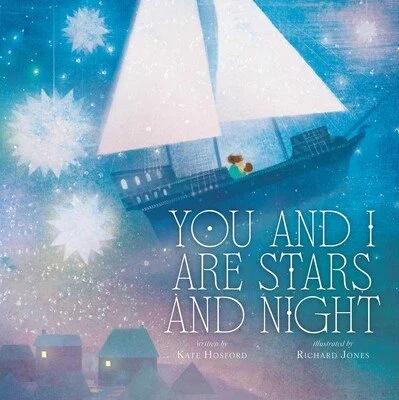
Now Kate has a new picture book out, You and I Are Stars and Night, illustrated by Richard Jones. The book is a rhythmic lullaby with a rhyming pattern that feels like waves, from the wind sweeping through a sleeping village, all the way to a bedtime ship sailing into a starry night. It’s of those bedtime books that invites a child to linger on its pages, to snuggle into the bedtime read, and even to predict the end rhyme of each spread.
Here’s Kate on the making of her dreamy, playful book.
Leading with the Unconscious: The Power of Metaphor
In The Practice of Poetry: Writing Exercise from Poets who Teach, Susan Mitchell says “Simile and metaphor require a new way of thinking where the writer leads with unconscious or irrational thought processes, then waits for the conscious thinking to catch up. Metaphor and simile allow us to say what we might otherwise be unable to say, because it would simply fall through the sieve of conventional language.” (p52)
“One of the things I love about writing rhyming poetry is that the constraints it provides allow me to tap into my unconscious.”
When I began writing You and I are Stars and Night, I didn’t know exactly where I was heading. I had an image of a caregiver and child running out of the house in the middle of the night to embark on a seafaring adventure. I also knew that I wanted to write a love poem in rhymed verse and in the adult’s voice. I started playing around with the first stanza and eventually came up with this: The wind is calling. hear it sweep / Through our village fast asleep. / Will you sail away with me? / You and I are salt and sea.
One of the things I love about writing rhyming poetry is that the constraints it provides allow me to tap into my unconscious. While the logical part of my brain is puzzling over rhyme and meter, my unconscious comes up with the story and metaphors. I slip into a kind of dream state, knowing that I can revise for clarity later.
In the end, “You and I are salt and sea,” provided the refrain structure for the entire story. After listening to a couple pages, children will probably know that a love metaphor is coming at the end of each stanza, and they’ll know its structure, but they might not know what the metaphor will be. I now realize that this combination of reliability and surprise in the metaphor structure mirrors the behavior of a caretaker who is repeatedly expressing her love to her child while taking them both on a bedtime adventure.
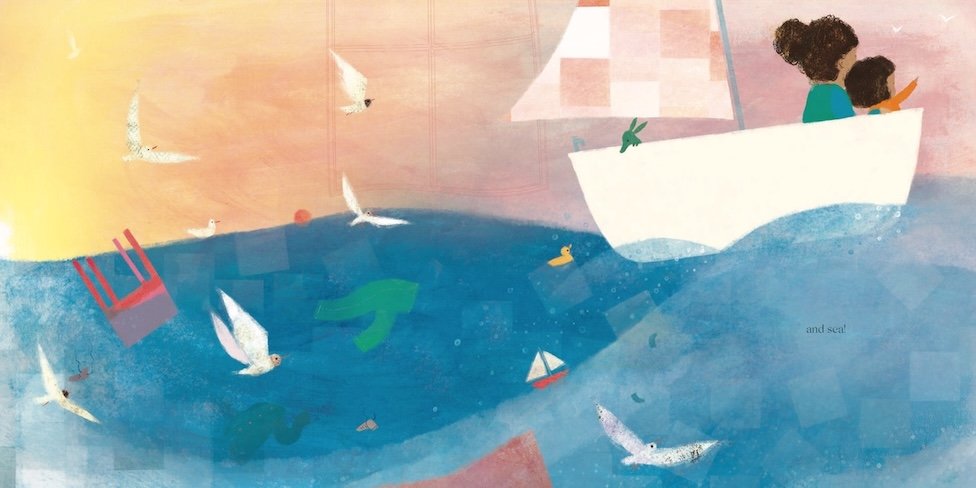
Image spread with words “…and sea.” Image courtesy of Kate Hosford, illustration © Richard Jones
The metaphors in this story have various sensibilities that express different facets of love: some are cosmic like You and I are stars and night, or intimate, like You and I are egg and nest, or playful like You and I are slip and slide. In every case, illustrator Richard Jones met the emotional moment perfectly and amplified the sensibility of the metaphor. My hope is that the combination of these metaphors with his beautiful illustrations will allow readers to feel the emotions that fall through the sieve of conventional language. Ultimately, I hope to reassure children that no one needs to set sail on the journey of life alone. And if the seas should grow stormy, a beloved caregiver will always be there to help them find their way back home.
“The emotions that fall through the sieve of conventional language.” Kate’s book taps them through her careful choice of words, while Richard Jones simultaneously evokes them through a shifting palette, a moving skyline and dramatic use of white space.