Process Talk: Pooja Makhijani on Bread Is Love
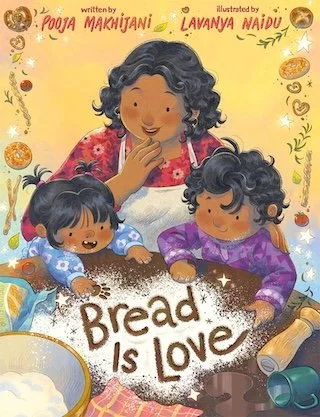
My writing path has crossed Pooja Makhijani’s many times since I first came across her essay, "The First Time," in the November/December 2003 issue of Cicada magazine, an essay for which she won that year’s SCBWI Magazine Award Honor in Nonfiction. Years later, we chatted about the first Asian American to win the Newbery Medal—Dhan Gopal Mukerji, in 1928. That conversation and others led to her terrific article in The Atlantic on the implications, of this forgotten history of American children’s literature. Pooja’s picture book, Mama’s Saris, captured the delights of dressing up, the allure of beautiful fabric and the longing of a little girl to celebrate identity in her own way. Now another picture book, Bread is Love, illustrated by Lavanya Naidu, similarly blends sensory moments with the delicious warmth of shared family connections. Welcome to WWBT, Pooja!
[Uma] What was it that drew you to making bread and how did that interest translate to a picture book?
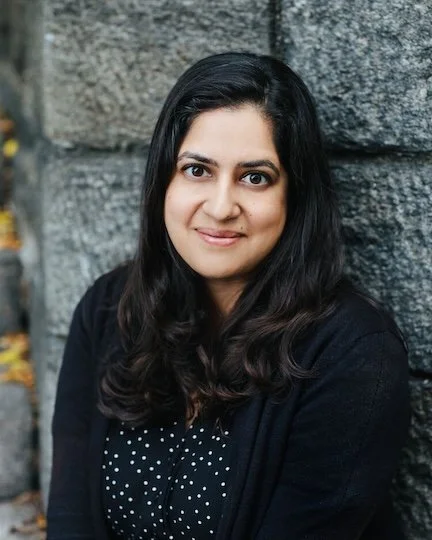
Photo © Sylvie Rosokoff
[Pooja] I fell into—and in love with—bread baking during a challenging divorce almost a decade ago. It quickly became a life-changing practice, easing my anxiety, enriching my relationships, providing literal nourishment, feeding me as an artist and photographer.
I had always loved picture books. I found some precocious (accidental?) success in 2007 with my first picture book, Mama’s Saris, but couldn’t really find my footing or momentum in the industry at the time.
It was the pandemic that prompted me to take an inventory of my creative ambitions, and I decided to recommit to writing picture books. Writing a picture book about bread and celebrating all that it came to mean to me—science, self-care, sustenance, sharing—just made sense.
[Uma] Like bread itself, Bread Is Love seems simple but there’s a lot bubbling beneath the surface—time and patience, repeated cycles of work. And oh, the delights when you are done! Can you talk about the process of creating the text for this book? What changed from early drafts to the final text? Any analogies to making bread would be welcome.
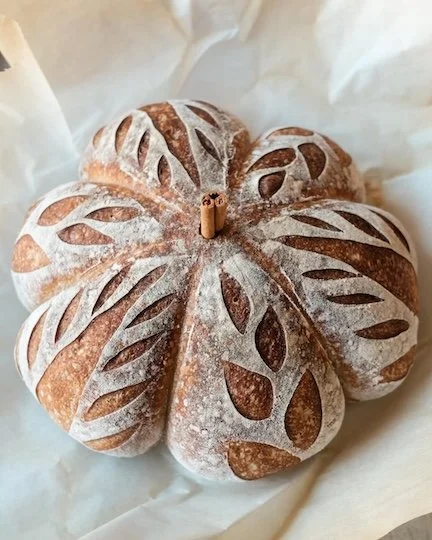
Photo © Pooja Makhijani
[Pooja] In late 2021, I wrote a manuscript about a Makhijani family ritual—“baking in” the new year. On New Year’s Eve, we try a new recipe, and our grand plan includes taking our baked good out of the oven at the stroke of midnight. The baked treat then becomes breakfast on January 1. Saba Sulaiman, my agent, didn’t think the manuscript was “hook-y, high concept” enough for the market, so I put it back in the metaphorical drawer and went on sub with another manuscript. Some months later, we received an email from Connie Hsu, v-p and executive editorial director at Macmillan. Connie passed on the story we’d sent her, but returned to us with a proposal: Would Pooja be interested in writing a story about bread?
Some backstory: Connie and I’d met when she was an editorial assistant at Little, Brown Books for Young Readers and had shepherded a foreign rights deal for Mama’s Saris (!). We stayed in touch via social media, and she had seen my bread journey unfold online.
I said yes, of course. I’d written the steps of baking a loaf (gathering ingredients, mixing, fermenting, shaping, and so forth) in the bake-in-the-new-year story, and much of that technical language carried over to the rewrite. In the new version, I added the layers that the earlier version was missing: of patience, adaptability, and observation as essential baking skills; how practice pushes you to nurture, and persevere, and excel; how the process of baking fosters optimism; how bread connects us across cultures.
“Picture book writing is a practice in restraint. When polishing a draft, I always think about what can’t be shown in art, like interiority or subtext. ”
[Uma] There's a life lesson tucked away here--that sometimes we have to cope with disappointment. You talk about this in the afterword but in the text, it's shown in only a few brief lines when the loaf deflates. How do we say more with fewer words in crafting picture book text?
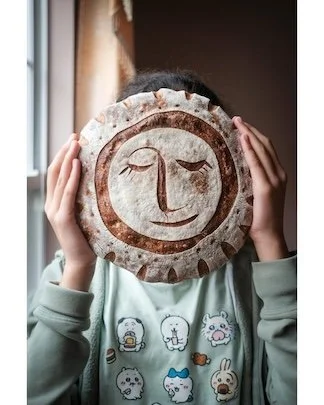
Photo © Pooja Makhijani
[Pooja] Picture book writing is a practice in restraint. When polishing a draft, I always think about what can’t be shown in art, like interiority or subtext. I consider page turns and white space: What’s the least I can say that still propels the story? This text incorporates repetition, alliteration, and assonance, which provide structure, add pulse, and shape mood—heightening tension and emotion without adding words. I’m also a fan of the specific, well-placed sensory detail which can convey so much.
[Uma] What do you love most about picture books?
[Pooja] As a reader, I love how text and pictures, covers and end pages, and details of design work together to create a unified whole. During my hiatus from writing picture books, I discovered the book arts/traditional practices of the art of the book, which gave me a greater appreciation for the picture book as much an art/sculptural object as a work of fiction or nonfiction.
As a writer, I love the collaborative process of making a picture book. It takes so many people to provide an aesthetically satisfying experience for young readers—and I feel privileged to be a part of that.
[Uma] What surprised and delighted you about the artwork? And did anything change in the text once the art came in?
[Pooja] Lavanya is a sorceress. Her illustrations are whimsical and filled with wonder and nostalgia. She has such a mastery of light and shadow: Bread Is Love takes place over a weekend, and she uses directional light and color to evoke so much emotion as well as the passage of time. Her illustrations give the book a sort of hushed, contemplative mood, as if the reader has stepped into a moment suspended between before and after.
When writing the manuscript, I’d imagined a mother and her school-aged daughter in the kitchen; we writers often use personal frames of reference in our art. But Lavanya created a third character—a toddler-aged sibling who is sprightly and silly. She has her own bread making journey. Her face is so emotive! Lavanya added a wordless layer to the story that I could never have imagined.
[Uma] Is there anything else you'd like to tell me about the process of creating this book?
[Pooja] I wrote Bread Is Love to remind readers to find joy in the process and not in the product, especially in an era in which artificial intelligence can spit out “art” in mere microseconds. I want readers to embrace the chaos and the unexpected as they learn and experiment in whatever their art form is. Life is messy and wildly imperfect and occasionally underproofed (sorry!)—which is exactly what makes it worth living.
Thank you, Pooja. I’ll end with a passage from the book:
Sometimes our loaf is what we want – big like a ball, with a shiny, brown, blistered crust. Sometimes, it collapses. Flat like a Frisbee. Bread is unpredictable. “Will it be magic?” I ask. “Or mayhem?” Mama says.
Bread is Love finds many ways to circle back to the inescapable analogy with life that remains part of the age-old allure of bread. Here, it’s held lovingly within the child-size container of a picture book.