“Not a Fairy Tale.” Women of the Fairy Tale Resistance by Jane Harrington
From the moment I first heard of Women of the Fairy Tale Resistance by Jane Harrington, I was intrigued. It’s a compendium of stories by the group of women in the subtitle: “the forgotten founding mothers of the fairy tale.”
Founding mothers? How come I’d never heard of them? Think of the fairy tale in the Western world and one naturally thinks of Charles Perrault, right? And after him, the Brothers Grimm. And later Hans Christian Andersen. Not a founding mother in sight. That is the assumption Harrington takes aim at.
Of her book, Jane Harrington wrote in The Orange & Bee substack:
It’s an interwoven work of biographies and stories, featuring seven of the conteuses—Marie-Catherine d’Aulnoy, Charlotte-Rose de La Force, Henriette-Julie de Murat, Marie-Jeanne L’Héritier, Catherine Bernard, Catherine Durand, and Louise d’Auneuil—who together wrote more than seventy tales while bravely pushing against the homophobic, misogynistic, ultra-conservative reign of Louis XIV. These histories, though necessarily brief (erasure was real, and there’s only so much that can be recovered), are deeply researched yet conveyed not in an academic tone but in a conversational voice, something these salon writers favored in their own writing.
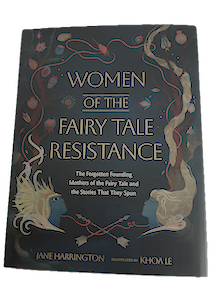
I knew I’d need to make time and space in my reading/writing life for this book. Mind you, it’s one of those books that needs both time and space. No bedtime reading here. My aging wrists couldn’t possibly hold up this nicely sized volume for as long as I’d want to read it. Also, you need to set it down on a table in good light to make the most of its beautifully designed pages. There’s an e-book edition but trust me, this is a book you want to hold in your hands.
And so to the jacket, because it’s critical to how this book steps out and reclaims the art form it’s talking about. No photo can do justice to this jacket.
Deeply researched works on the history of storytelling do not usually have such captivating jackets. It’s not just the gold foil, although that’s perfectly gorgeous all by itself. Vietnamese artist Khoa Le uses the black background to eye-popping effect with her line work and profiled faces, and with the floral motifs in the upper third that contrast with the drama of crossed arrows on the bottom half of the jacket art. And there’s more luscious art inside the book. Each section, focusing on one of the women storytellers, has at least one lavishly decorated first page and one full-page piece of art, and many have additional spot art to arrest attention and delight the eye. Hang on, though. If you think about the lives of these women, meeting in salons thought to be hotbeds of radical thought at the time of the boy king Louis XIV—well, okay, you’d want a cover worthy of that complexity and sufficiently tinged with luxury as well.
Each section consists of a biographical account of one of the conteuses and a sampler of stories from her work. But the thing that makes this book so engaging is that conversational voice Harrington mentions. At times, it’s downright chatty. Like this excerpt from the life of Marie-Catherine d’Aulnoy:
Lès majesté was no petty crime; it was a capital offence that could result in execution. If Marie-Catherine had any compunction about bringing to light her husband's high treason, one can assume that her mother, who took the lead on this project, had no qualms. Judith-Angélique’s feelings for her son-in-law, as per multiple sources, had by this time turned to “hatred.” Mother and daughter hatched a simple plan: they would hire a couple of cavaliers to befriend Baron D’Aulnoy, witness his crime, and turn him in. What could go wrong?
Oh, my. Then there are the stories, retellings of a dozen of the original tales that bring the salon sisters’ characters to life with spice and energy.
Example:
Once upon a time there was a king who feared that his three sons would be seized with the desire to reign before his death. He was a distrustful sort, the king. And selfish. And scheming. So he hatched a plan to divert his sons with promises he could escape fulfilling.
And another—note how the usual flatness of fairy tale characters gives way here to interior spaces and reflection:
…for all Plousine’s power, for all the hearts she touched or inflamed, her own heart remained unaffected. She soon grew weary and began spending long periods at a retreat she had wished for, a short distance from the capital. It was not opulent but had a charming simplicity. A forest surrounded it, with paths intersected by brooks that formed natural cascades. She often walked these paths, sighing, and one day her heart felt more than usually oppressed, so she seated herself in the grass beside a rivulet whose gentle murmur courted meditation.
I ask you, cautiously, because this isn’t anything I can claim expertise in, but it occurs to me this is a commonsensical sort of question: is it just possible that the traditional telling of fairy tales lacked emotional depth because, well, a bunch of guys were doing the retelling?
Among all the stories with their grand array of animal, supernatural, and human characters, the women suffer, are beaten down, go on journeys, find allies, forge relationships. They push back, they escape—and in all, they endure. I read the entire book in big, delicious chunks, and felt as if I’d been in a kind of women’s salon myself, invited by Harrington to speculate, to wonder, and also to enter a forgotten story world whose tellers refused, just refused, to condescend. Take that, Perrault and Grimm. Here’s a whole other window on what constitutes a fairy tale.