Writing With a Broken Tusk

Writing With a Broken Tusk began in 2006 as a blog about overlapping geographies, personal and real-world, and writing books for children. Since March 2024, Jen Breach (writer, VCFA graduate, and former student) has helped me curate and manage guest posts and Process Talk pieces on this blog.
The blog name refers to the mythical pact between the poet Vyaasa and the Hindu elephant headed god Ganesha who was his scribe during the composition of the epic narrative, the Mahabharata. It also refers to my second published book, edited by the generous and brilliant Diantha Thorpe of Linnet Books/The Shoe String Press, published in 1996, acquired and republished by August House, now part of Reading Is Fundamental, and still miraculously in print.
Posts on this site reflect personal opinion and commentary protected under the Canadian Charter of Rights and Freedoms and the First Amendment of the US Constitution.
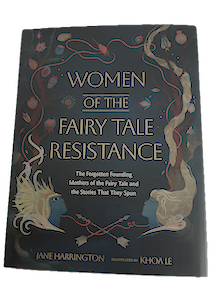
“Not a Fairy Tale.” Women of the Fairy Tale Resistance by Jane Harrington
From the moment I first heard of Women of the Fairy Tale Resistance by Jane Harrington, I was intrigued. It’s a compendium of stories by the group of women in the subtitle: “the forgotten founding mothers of the fairy tale.”
Founding mothers? How come I’d never heard of them? Think of the fairy tale in the Western world and one naturally thinks of Charles Perrault, right? And after him, the Brothers Grimm. And later Hans Christian Andersen. Not a founding mother in sight. That is the assumption Harrington takes aim at.
Of her book, Jane Harrington wrote in The Orange & Bee substack:
It’s an interwoven work of biographies and stories, featuring seven of the conteuses—Marie-Catherine d’Aulnoy, Charlotte-Rose de La Force, Henriette-Julie de Murat, Marie-Jeanne L’Héritier, Catherine Bernard, Catherine Durand, and Louise d’Auneuil—who together wrote more than seventy tales while bravely pushing against the homophobic, misogynistic, ultra-conservative reign of Louis XIV. These histories, though necessarily brief (erasure was real, and there’s only so much that can be recovered), are deeply researched yet conveyed not in an academic tone but in a conversational voice, something these salon writers favored in their own writing.