Landscape and Language in Robert Macfarlane’s Is a River Alive?
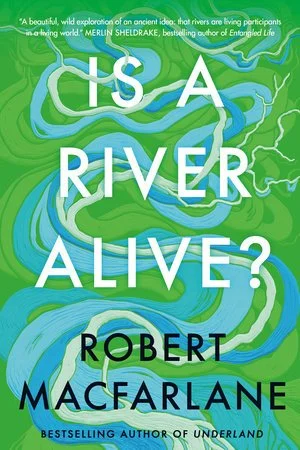
In Landmarks, Robert Macfarlane wrote about the land in ways that made me feel as if I could touch the moss and hear the water flow. His prose enchanted, prompting me to read out loud. But I have only ever been a tourist in England, so while I was dazzled by the intricate connections of land and language, Landmarks, on the whole, spoke to me intellectually rather than emotionally. This book is different. Is a River Alive? flows through three distinct waterscapes and links them inescapably with our own human water bodies.
I read the book out of order, heading straight to the Chennai section. My mother was born there and so was my late ex-husband. My grandfather retired there briefly before he moved to Bangalore, where he passed away when I was only 11, a formative age whose memories live within me still.
I have book connections to the city. Naming Maya is set in Chennai. The Book Uncle trilogy is set in a fictional, unnamed city that is a smaller, slightly less frenetic version.
I know Chennai’s streets. I have seen the ancient tanks, the eri that form part of a hydrological system forgotten for centuries and now being rediscovered. I’ve been to Vedanthangal to see migratory birds fly in for the winter. I’ve seen the degradation of the city’s rivers. The endangered mangroves fringing its estuaries found a place in The Sunshine Project, the last of my Book Uncle books. But I didn’t know I’d find Yuvan Aves in these pages. He is the author of Shorewalk, a picture book I refer to in The Sunshine Project. Here, his moving personal story enfolds the tale of Chennai’s waterscape. It touches the ancient past, colonial history, and decades of unregulated urban sprawl before pouring into the troubled present. It came home all the way into my heart and made me tear up as I read.
“The next morning we walk into the forest and it swallows us whole.”
I tried to get a grip on myself and on the text. This setting’s in my bones, I thought, so naturally, I’m touched by seeing it centered. Yet as I dipped into the other sections, Los Cedros in Ecuador similarly gripped me. The extraordinary image of light-emitting fungi in a rescued yet still imperiled forest reached watery fingers into my reading of Suzanne Simard’s Finding the Mother Tree and Richard Power’s The Overstory. The setting called on me to be an ear-witness, to listen to the soundscape of a forest. It rendered up forest as an entire, living entity:
Example: The next morning we walk into the forest and it swallows us whole.
I marveled at those who dedicate themselves to the study of the natural world, like the fungi-whispering Giuliana. Macfarlane writes that Chennai complicated his sense of what Los Cedros showed him, but by then I had read the book all out of order, from the middle outward, like a rescuer feeling in a sandy turtle nest for eggs to save in a dedicated hatchery. In between, I sampled vignettes of the chalk-stream near the author’s house, yet another water body whose continued existence is in jeopardy.
I confess to reading the ending chapter before I settled into the Canadian setting of Part III. The imagined ending scene forced me to consider possibilities of ache and joy mingled in a future beyond the author’s life. It gave me permission to imagine such a future for my own children and grandchildren. Imagining, Macfarlane seems to say, is not delusional but necessary.
Perhaps the words of Innu artist and activist Lydia Mestokosho-Paradis best express the heart of this book:
It seems crazy that we give a corporation that’s ten years old rights, but we won’t give rights to a ten-thousand-year old river.
The argument for recognizing the rights of the natural world is bolstered by voices and ideas from the recent and more remote past: George Elliot, Ursula Le Guin, Leonardo da Vinci, and Hieronymus Bosch. Descriptive asides draw on sources from Asterix to classic sci-fi. Is a River Alive? led me to unending connections to my past, to my present, to everything else I’ve read. Its magic lies in its loving use of words. It turned wordlight and riverflow upon the danger we humans have visited on our deeply interconnected world.
“The history of literature,” Macfarlane writes, “is littered with the debris of attempts to utter water: a vast Oort cloud of fragments shrouding a presence which declines articulation and resists correspondence.” Reflecting on this at the year’s end, it occurs to me that maybe articulation isn’t the point, or maybe we do it for our own sake rather than for the river.
Who are we, after all, to give rights to a river? When it floods, it claims its own terrain.