Process Talk: Cybèle Young on My Pet Tardigrade
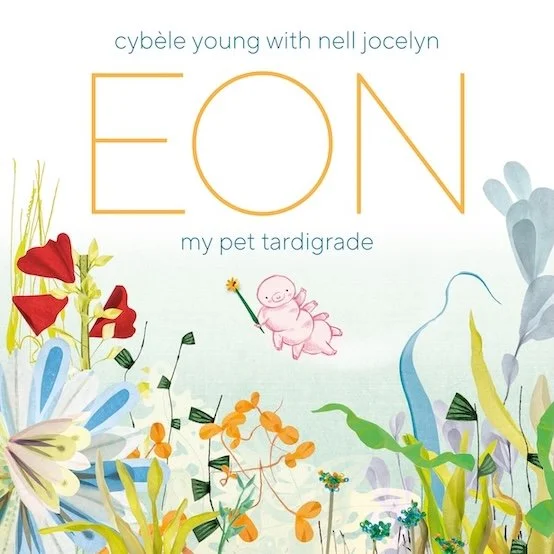
Tardigrades belong to the more than 1,100 species of free-living tiny invertebrates living in habitats ranging from moss to sand to fresh water to oceans. I’m willing to bet there are not too many people who can claim to have met one but Cybèle Young has. The experience led to her writing a picture book that combines a child’s imaginings with the science of this peculiar little creature whose other names, endearingly, are “moss piglet” and “water bear.”
When life isn’t good—when it’s too cold or dry, for instance—a tardigrade can do something astonishing. It can go into a state of suspended animation and turn into a little speck of matter called a tun. Just that word, so small and easy to toss out, makes me smile. Tuns can stay still and specky and inert for years, even decades.
Cybèle’s book, a fictional first person narrative of a child encountering a tardigrade, is illustrated with her own graphite pencil drawings as well as Japanese paper sculptures. Additional art was contributed by Nell Jocelyn. The effect brings a delicate microscopic world to life, so that the little tardigrade plods along among “other teeny beings who wiggled and jumped.” The girl’s affection for her remarkable pet also finds visual expression in a profusion of folded hearts that float across the spread, and in the tiny imaginary world of amusement and leisure that she seeks to create. A startling moment precedes one of discovery, before a resplendent foldout page reveals the possibilities inherent in caring for a living being you can’t quite understand.
Here’s my e-mail exchange with Cybèle Young about the making of this book, a simple child-centred story with an unusual animal character, undergirded by astonishing information about a part of the natural world of which most of us remain completely unaware.
1. I was surprised to find out that humans have known about creatures like your little Eon for more than a couple of centuries. German naturalist Johann August Ephraim Goeze first described them in 1773! Amazing little creatures, and you’ve actually met one! Can you tell me about that first encounter that you reference in the back matter of Eon: My Pet Tardigrade?
2. How did you know that you had to tell this story? Also, how did you know that it had to be a picture book?

Photo courtesy of Cybèle Young
3. There are bigger questions implicit in your book. The youngest readers may not see them, but they could well emerge for readers who return to the book repeatedly over a year or two—the kind of recursive reading that makes readers out of picture book listeners. They are questions of pets and ownership, stewardship, responsibility for the natural world.... there is so much here to unpack. What are the underlying strands of your book that you’d like young readers to hold in their minds and hearts?
4. The art in this book combines line work and cut paper to create a remarkable effect of the human, easily visible world juxtaposed with a microscopic one. Talk about how you visualized the illustration working in your book and in particular the effects of the different media you have employed.
5. Anything else you’d like to say? Put it here and I’ll frame transitions to suit.