Process Talk: Martha Brockenbrough on A Gift of Dust
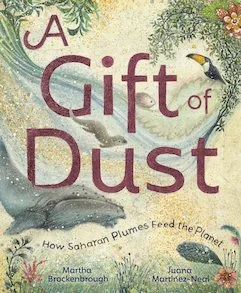
Martha Brockenbrough (she who wrote an amazingly perceptive book about 45-47, way before rising numbers of the public cottoned onto his deceits and conceits) has now written a picture book that dazzles while it informs. A Gift of Dust: How Saharan Plumes Feed the Planet sings in rhythms, plays with words, and manages to make room for its audience in the magnificent world it encircles. All the way from “that certain slant of light” in the opening to the single word “tomorrow” on the last spread, the text pays simultaneous homage to poetry and the science of a single marvelous natural phenomenon. I asked Martha to tell me more about where this book came from.
[Uma] To me, this book seems to be speaking to other picture books but especially to Marion Dane Bauer’s cosmic-scale The Stuff of Stars and We, the Curious Ones. And to the stream of bad news circling the globe, and books that deliver important but terrible news about the state of the natural world. But that’s my skewed viewpoint so I want to know—what are the books (and/or the issues in the world) that you see this book in conversation with? And why does that matter for our picture book audience of very young readers and listeners?
“We are connected to each other. We are connected across years. We are connected across distances. We are connected as opposites—wet and dry, big and small, young and grown. ”
[Martha] For sure, this is in conversation with Marion Dane Bauer’s work. I also loved the poetry of Liz Garton Scanlon’s One Dark Bird. But I do let the adult nonfiction I read wholly into my heart. The work of Oliver Sacks led me to another nonfiction picture book called Darwin’s Orchids, for example. Merlin Sheldrake’s Entangled Life also spoke to the feeling I have that the connections between organisms are as meaningful as the individual organisms themselves.
When I thought about what I wanted to share with young readers, it was that idea—that the planet truly is a web of life, and that it is not just a spatial relationship but also a temporal one. We are connected to each other. We are connected across years. We are connected across distances. We are connected as opposites—wet and dry, big and small, young and grown. And I wanted to begin the book zoomed in on something very small, a speckle of dust, because children, too, are small. But they are so significant. (In that, I suppose, there is a bit of Horton Hears a Who.)
Learning about the Saharan dust stream filled me with wonder and awe. Children are really good at experiencing these emotions. I still remember holding my daughter as she tipped her face toward her first-ever raindrops. The way she looked at the sparkly elevator lights and cooed. My hope was to give children those emotions inside the pages of books, not just so that they learn the material but so that they begin to understand that books are places to turn to refill their cups of wonder and bowls of awe.

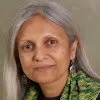
Martha Brockenbrough. Photo by Emerald England
[Uma] Information is only one element, yet we often treat it as if it’s the whole ball of yarn. How did this come together for you? What part of it crystallized from the beginning and how much emerged or changed or fell away through revision?
[Martha] This feels terrible to admit—but I wrote the draft of this riding a burst of emotion. I did revise, of course (OF COURSE). But the lyrical approach has stayed largely the same.
[Uma] Not terrible at all. Some books show up and call out loud to be written and that’s a gift. But to the revision, OF COURSE…
[Martha] I made some changes to the metaphors and language to tie them more closely to the Amazon. Mangos and maracujá are native fruit.
[Uma] Well, mangos may not be technically native, having arrived via the Portuguese from India and Southeast Asia, but they’ve certainly been around long enough to become culturally established. And the stacked-up capybara are purely joyful.
[Martha] My original draft had giraffes, chosen because I was demonstrating height. But why not stack a capybara? For me, the process of revision was all about making the words particular to the places, trusting that the child will understand enough through the context.
I absolutely love Juana Martinez Neal’s illustrations. I gasped and wept when I saw the sketches, particularly the image of the mother whale and calf. Picture book texts create space for illustrations. A picture book does not belong to the author. It is a shared creation. When I write picture books, I am essentially writing an invitation for an illustrator to see the possibilities and pick up on the threads. Juana did exactly this with all the mother/child imagery of the book. Even the astronaut’s tether feels like an umbilical cord. And the way the book begins with expectation and ends with a child—absolutely marvelous. There were no illustration notes. This was all Juana understanding what was important and what had potential for more.
“Shared creation” and “writing an invitation.” Those are spot-on descriptors of how to write a picture book. Note that there’s a playfulness in this one that absolutely evokes the tipping of young faces toward first raindrops. Just goes to show what magic can be made when you have a writer and illustrator. both adept in their respective art and craft, both serving the heart of the story.
This may be an old world spinning through turmoil but here’s a book that opens it up. A gift to picture book readers for whom it will all be new and fresh.