Process Talk: Andrée Poulin on Planting Sunshine
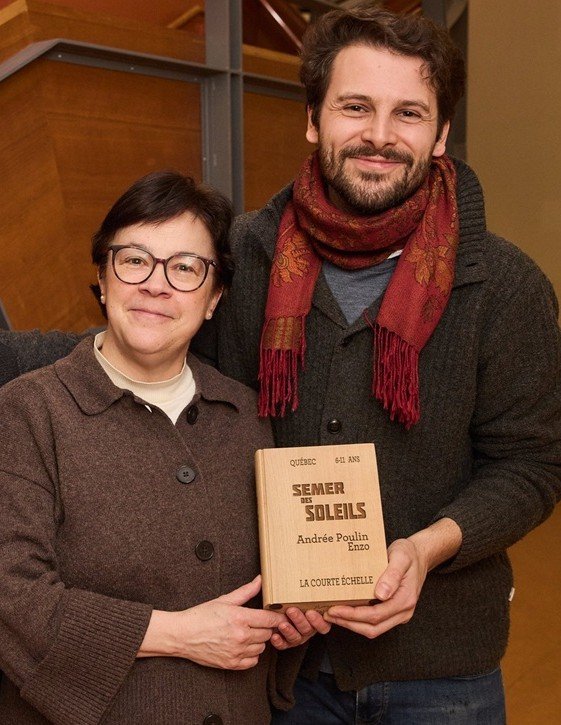
Andrée and illustrator Enzo. Photo courtesy of Andrée Poulin
Children live in the same world as we do. It’s a world with violence, inequity, discrimination, hatred. It’s a world in which wars break out, drag on, reignite. If we pretend otherwise, imagining childhood as a magical place sealed off from reality, we’re deluding ourselves. Denying knowledge of war to children living in the relative privilege of a peacetime society only propagates the notion that we don’t really have to care about other people’s children, who may not be as lucky as our own.
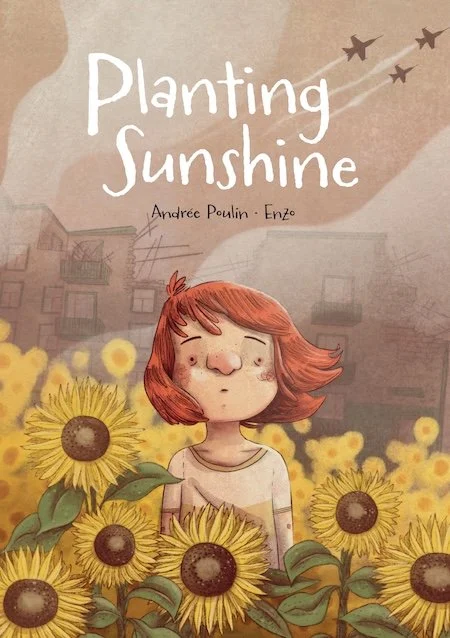
Also, children are not easily duped. If there’s something we try to hide from them, that is the very thing they will do their best to ferret out. These are the knotty issues taken on by an unlikely text—Planting Sunshine is a slender novella in verse by Quebec writer Andrée Poulin, illustrated by Montreal-based musician and artist Enzo. I invited Andrée Poulin to tell me more about the making of this little jewel of a book.
[Uma] By opening in an ordinary scene, father and son shooting hoops, with Theo more capable than his father, the child reader is given agency in an adult world. Can you talk about how this story and Theo's character developed for you?
[Andrée] In the first days of the war in Ukraine in February 2022, I was glued to the news, checking it every hour. I was deeply upset and couldn't stop thinking about one question: how can humans do this to other humans? And I realized… kids are probably asking the same thing. That’s when I decided to write a story about war from the perspective of a child who's watching these horrors unfold in some distant country. There aren't many children's books that explore how war affects kids living in peaceful places.
I wanted to show how absurd and horrifying war is, without offering easy answers or neat solutions. As for the relationship between Theo and his father, I wanted to show adults who don't have all the answers to their kid's questions. I wanted Theo's father to be imperfect and vulnerable, because that's what real life looks like.
[Uma] The art plays a really interesting role in this story, making it more than a verse novella, using picture book techniques to grow the story, making the eye dance from text to image and back again. Images like the sunflowers and the birds, powerful in words, become irresistible in art. Then there are spreads with what I can only describe as visual poems, just titles--and the image says the rest. It makes me wonder, what if anything changed in your text as the art took shape?
[Andrée] While I was writing the book, I already had illustrations in mind. I knew I wanted full-page illustrations without any text. That's my way of getting readers to really look and notice things. So I gave the illustrator clear guidelines on that front. What was interesting, though, was that Enzo ignored some of my suggestions and added scenes he wanted to show instead. I love when illustrators surprise me like that.
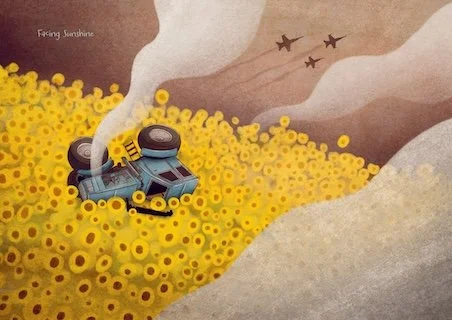
The illustration added by Enzo led to this wordless poem, “Facing Sunshine,” in Planting Sunshine by Andrée Poulin. Image courtesy of Groundwood Books
[Uma] The art really does make magic in this book, but there’s also hard stuff in here. When Theo's dad turns off the news, he’s trying to protect his son but To Theo it feels as if his father's denying the validity of his questions. How do you see your role as a writer for young readers living in an increasingly complex and bewildering world?
[Andrée] Talking about the horrors of war with kids is never easy, and there's no perfect moment to explain that cruelty and wickedness exist in our world. But the reality is, war is already part of children’s lives. They see it on their phones, tablets, and TVs. So instead of dodging the subject, I think we need to face it head-on, especially through children’s books. That way, we meet kids where they are. The French writer Robert Escarpit put it well: we need to give kids the tools and information to navigate a world that isn't always fair or peaceful.
I wanted to write about war for young readers for a few reasons. First, it helps build tolerance and openness. You can't truly understand or accept others without knowing something about how they live. It's that basic awareness that builds bridges. Second, it shapes their social conscience. We're raising tomorrow's citizens and they need to grapple with these realities to become thoughtful, engaged members of society.
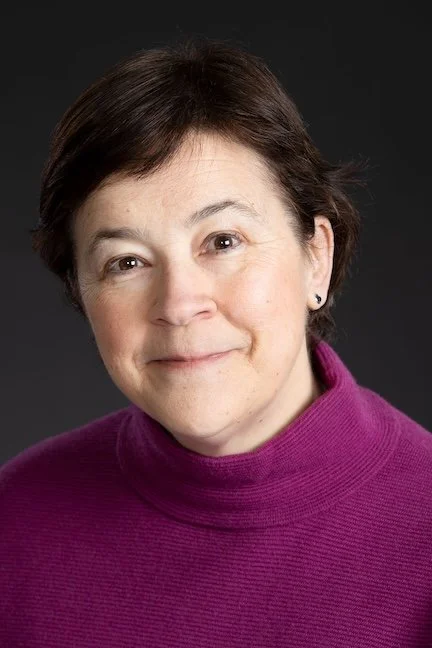
Andrée Poulin: Photo © Martine Doyon
[Uma] The turning points in your story are all emotional moments—between Theo and Dad, or with the green-haired artist. Why is poetry a good vehicle for conveying such moments?
[Andrée] I've always felt that poetry has this unique way of getting straight to your heart. It doesn't try to explain things or lay everything out neatly, it simply lets us feel. A poem reaches us emotionally long before our minds catch up to what it’s saying. There’s something almost magical in the way emotions move through the music of words: the rhythm, the sounds, the carefully placed repetitions, even the silences between lines. What I love most is that poetry suggests. It opens space. The blank areas, the pauses, the things left unsaid, are often where the deepest meaning lives.
This openness also makes poetry a powerful way to approach difficult issues. By speaking indirectly, through images and emotion, poetry allows us to enter hard conversations gently, without defenses, making the unspeakable feel possible to face.
“By speaking indirectly, through images and emotion, poetry allows us to enter hard conversations gently, without defenses, making the unspeakable feel possible to face.”
Poetry also has this beautiful freedom to hold contradictions, to sit comfortably in ambiguity. It doesn’t rush toward tidy conclusions or force resolution where none exists. Sometimes the uncertainty, the messiness—that is the truth the poem is offering.
[Uma] Is there anything else you want readers to know?
[Andrée] Writing Planting Sunshine wasn’t easy, because the topic is heavy. One big question hung over me from the start: how do you talk to kids about war? I kept turning it over in my mind. Is there a right way to do it? A wrong way? How do you bring up something so bleak and despairing without crushing a child’s spirit? War, at its core, is absurd. How do you even begin to explain something that defies explanation, without leaving kids feeling scared or lost?
I constantly wrestled with finding that delicate balance. I needed to show the reality of war's horrors, but not at the cost of my young readers' sense of safety. What should I say? What should I hold back? How graphic is too graphic? Could I use words like "torture" or "genocide"? And then there was this particular challenge: how do I capture the anxiety that war creates in children without making my own readers anxious in the process?
What helped me through all of this was something children’s author Marie-Aude Murail once said: “Don’t let young people despair; always leave a light on.” That became my mantra.
So, while the novel doesn’t dodge the hard stuff, its ending offers something more—real steps kids can take, ways for them to find a little peace and push back against that feeling of helplessness.
Thank you, Andrée Poulin, for this book. Planting Sunshine is a tribute song to children and their capacity for reason and empathy.